All published articles of this journal are available on ScienceDirect.

Crystalline Admixtures for Self-Healing Cementitious Composites: A Comparative Review of Experimental Studies

Abstract
Cracking remains a major durability problem in cement-based materials because it facilitates the ingress of water and aggressive agents, accelerating deterioration. Crystalline Admixtures (CAs) have gained attention as a moisture-activated self-healing approach because they promote the formation of insoluble products within pores and cracks, thereby reducing crack connectivity and improving water tightness. This review compares the experimental evidence on CA-containing cementitious materials identified through manual searches of Scopus, Web of Science, and Google Scholar. Studies relevant to CA-assisted crack sealing, permeability or water-tightness recovery, mechanical recovery, durability performance, and microstructural changes were screened and comparatively evaluated. Evidence strength was assessed qualitatively according to the reporting of CA dosage, crack characteristics, healing conditions, test procedures, and quantitative outcomes, with greater confidence given when visual crack closure was supported by functional measurements. A central contribution of the review is the explicit distinction between direct crack-healing studies, durability-recovery studies, and durability-only investigations on uncracked specimens, thereby avoiding interpretation of different forms of evidence as equivalent. Across the reviewed literature, the most consistent benefit of CAs was improvement in water tightness and reduced permeability, while mechanical recovery was less consistently demonstrated. Healing was more consistently reported for relatively small cracks, particularly below approximately 0.3-0.4 mm, under water-rich or wet-dry conditions, whereas wider cracks showed greater dependence on moisture availability, healing duration, and hybrid approaches. The review identifies standardized testing, improved assessment of internal healing, CA-specific predictive modeling, optimized hybrid systems, and long-term field validation as major priorities for future research.
1. INTRODUCTION: CRACK HEALING IN CEMENT-BASED MATERIALS
Cracking in cement-based materials is unavoidable due to their low tensile strength and exposure to environmental and mechanical stresses. Shrinkage, thermal changes, and external loads can generate microcracks that propagate over time, creating pathways for water, chlorides, sulfates, CO2, and other harmful agents that accelerate reinforcement corrosion and deterioration (Fig. 1) [1-4]. Conventional repair methods are often costly, labor-intensive, and difficult to apply in buried or remote structures [2]. Repairing concrete structures requires good knowledge regarding the support to be repaired, the materials used for repair, and the environment to which they will be subjected [5]. Therefore, developing concrete capable of self-recovering after cracking is important for extending service life and reducing maintenance.
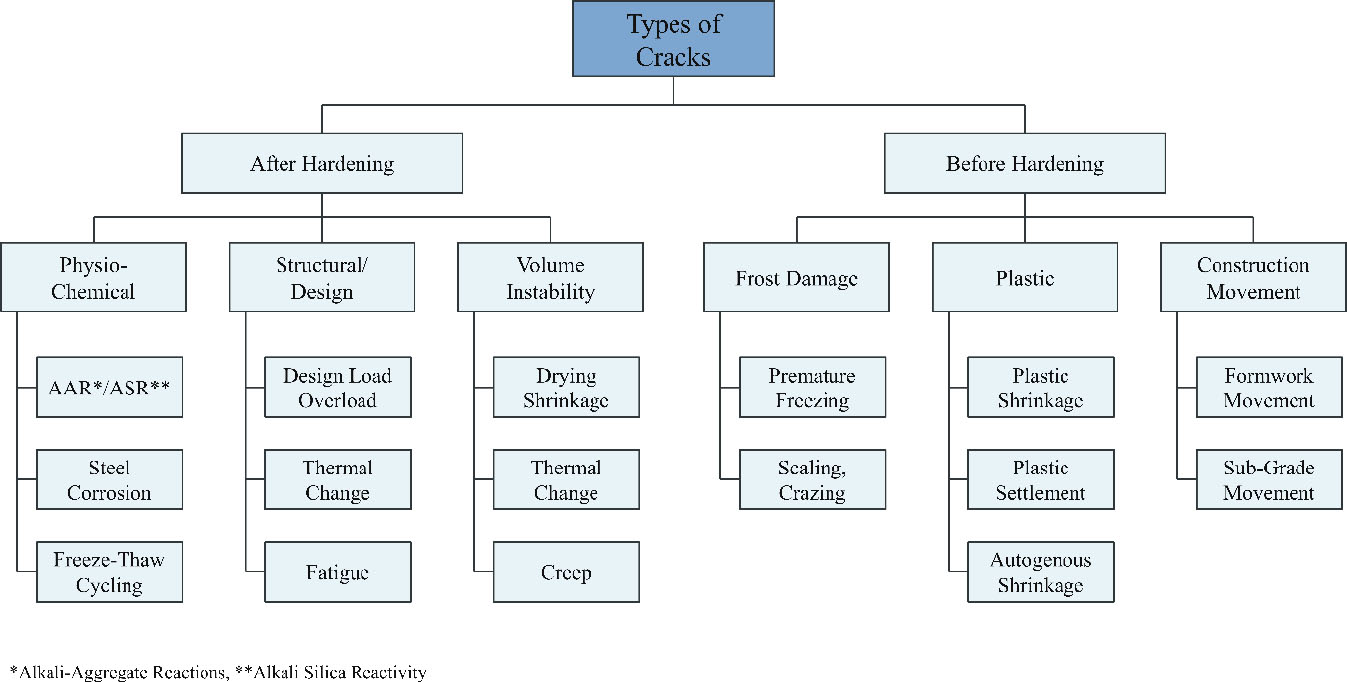
Common reasons for cracking in concrete constructions (adopted from [8]).
Self-healing concrete has emerged as a promising approach to address these durability issues. It refers to concrete’s ability to seal cracks without external intervention. Natural (autogenous) healing occurs through continued cement hydration or calcium carbonate precipitation but is typically limited to small cracks and early ages [2, 3]. To enhance this capability, engineered strategies such as encapsulated healing agents, bacteria-based precipitation, and Superabsorbent Polymers (SAPs) have been investigated [2]. These approaches activate crack-sealing reactions when water penetrates the crack, improving durability and reducing permeability and corrosion risks (Fig. 2) [2, 3]. Crystalline Admixtures (CAs) have gained attention as a practical self-healing technology. These powders, often called Cementitious Capillary Crystalline Waterproofing (CCCW), are added during concrete batching and typically contain Portland cement, fine sand, and proprietary chemicals.
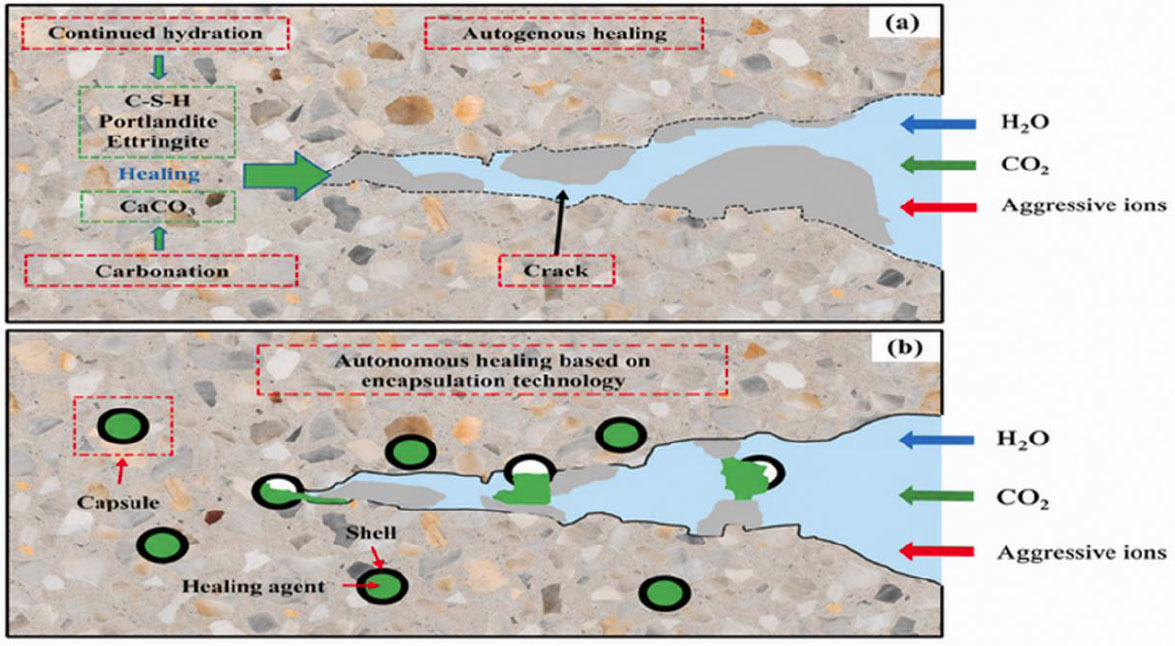
Mechanisms underlying autogenous and autonomous self-healing in cementitious materials (adopted from [10]).
In the presence of water, they react with calcium hydroxide and dehydrated cement phases to form insoluble crystalline precipitates within the pore structure (Fig. 3). These crystals fill capillary pores and microcracks, densifying the cement matrix and reducing permeability while becoming an integral part of the concrete [2, 6]. CA-treated concrete generally shows little change in fresh properties, and 28-day compressive strength is often comparable to or slightly higher than ordinary concrete [3, 7].
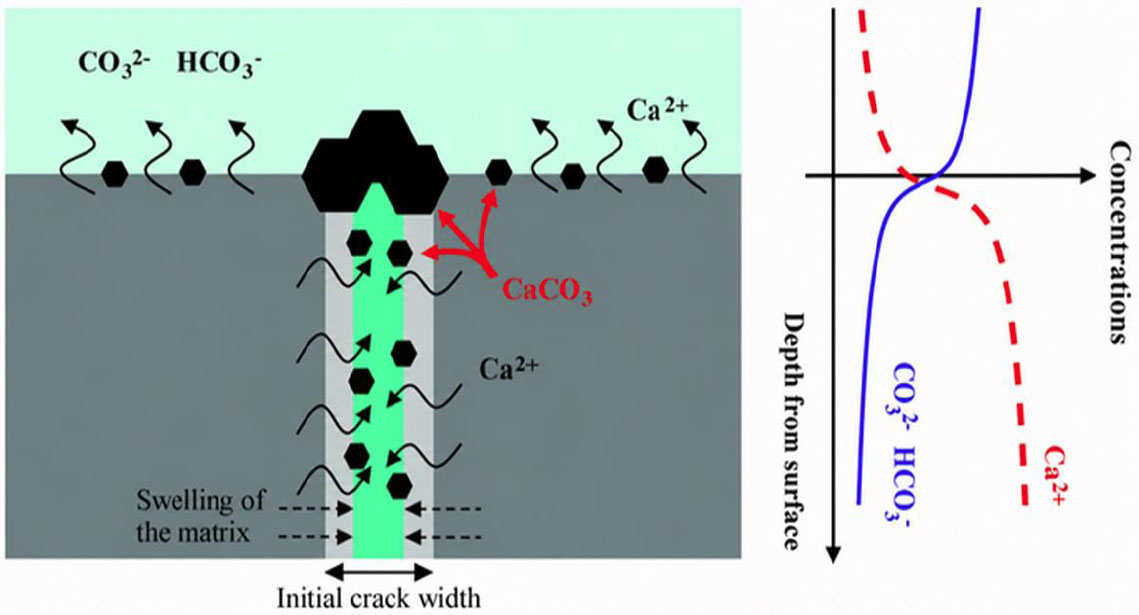
Schematic representation of calcium carbonate precipitation (adopted from [11]).
CAs also promote crack healing when moisture is present. Water entering a crack activates continued hydration and crystallization along crack surfaces, allowing cracks up to about 0.4-0.5 mm to be sealed by crystal growth [3, 9]. For example, Kryton (2014) reported that hairline cracks up to 0.5 mm can be sealed over time by new crystals [9]. These reactions also consume calcium hydroxide and form additional C-S-H, enabling partial strength recovery and reducing water sorptivity and chloride penetration [3, 7].
By modifying the pore structure, crystalline admixtures enhance durability and act as permeability-reducing admixtures under hydrostatic pressure (ACI PRAH), where water ingress can reactivate crystallization and seal microcracks [2, 9].
Several commercial Crystalline Admixture (CA) products demonstrate these principles, including Xypex Admix, Penetron Admix, and Kryton Krystol Internal Membrane [3, 9]. These powders are typically added during batching, while related crystal-forming coatings or slurries (e.g., Xypex, Aquafin-Mega, SikaWaterStop) are used for surface treatment. Crystalline admixtures have been applied in tunnels, dams, and bridges, with product selection depending on the application [3]. Industry reports indicate that such systems can self-seal cracks up to about 0.4 mm, reducing maintenance requirements [2, 9].
Studies over the past two decades identify crystalline admixtures as an effective and economical approach for promoting self-healing in concrete. Reviews report minimal effects on workability but significant improvements in crack closure and durability, including reduced permeability and chloride penetration [3, 7]. By enhancing natural autogenous healing and sustaining it during wetting cycles, CAs provide a practical approach to extending the service life of concrete infrastructure [2, 7].
In view of the growing interest in durable and sustainable infrastructure, crystalline admixtures have become an important topic in the development of self-healing cement-based materials. Numerous experimental studies conducted over the past two decades have investigated their ability to promote crack sealing, reduce permeability, and enhance long-term durability under different environmental conditions. However, the methodologies, mix designs, crack-induction procedures, healing environments, and evaluation techniques used across these studies vary considerably, making direct comparison difficult. Moreover, the available literature includes both direct crack-healing studies and durability-focused studies on uncracked specimens, which must be clearly distinguished when interpreting the evidence. Therefore, a comprehensive and comparative review of existing experimental work is needed to better understand the mechanisms, effectiveness, and limitations of crystalline admixtures in self-healing concrete. The following sections summarize and compare key studies, focusing on mix composition, testing methodology, healing conditions, crack width, crack closure, permeability reduction, mechanical recovery, and microstructural evidence. This comparative analysis aims to clarify the current state of research, distinguish surface crack closure from internal durability recovery, and identify future directions for standardized testing, predictive modeling, hybrid systems, and field application of crystalline admixture-based self-healing systems.
2. REVIEW METHODOLOGY
The literature considered in this review is identified through manual searches of Scopus, Web of Science, and Google Scholar. Different combinations of keywords related to crystalline admixtures and self-healing cementitious materials were used, including crystalline admixture, crystalline waterproofing admixture, cementitious capillary crystalline waterproofing, self-healing concrete, crack healing, crack sealing, water permeability, and cementitious materials. The retrieved publications were screened manually on the basis of their titles, abstracts, and, where necessary, full texts. Studies were retained for the main comparative analysis when they reported experimental evidence concerning crystalline admixtures in cement-based materials, particularly regarding crack sealing, permeability or water-tightness, mechanical recovery, durability performance, or microstructural changes. Publications unrelated to crystalline admixtures, as well as studies that did not provide information relevant to the scope of the review, were not included in the main comparative dataset.
The selected studies were evaluated comparatively because substantial differences existed in material composition, CA type and dosage, crack-induction method, initial crack width, healing condition, exposure duration, and evaluation technique. For each study, these parameters and the principal reported performance outcomes were extracted and summarized. Particular attention was given to distinguishing direct crack-healing studies from durability-recovery studies and durability-only investigations on uncracked specimens, since improvement in bulk permeability or matrix densification alone cannot be considered direct evidence of crack self-healing. Following this screening and classification, 80 experimental studies formed the main comparative basis of the review.
2.1. Study Quality and Evidence Assessment
The quality and strength of evidence provided by the included studies were considered during the comparative analysis because the reviewed investigations differed considerably in experimental design, material composition, crack-induction procedure, healing environment, exposure duration and evaluation method. Rather than treating all studies as providing the same level of evidence, greater confidence was placed on investigations that clearly reported the crystalline admixture type and dosage, crack-induction method, initial crack width, healing or exposure condition, testing procedure, and quantitative performance results. For studies addressing self-healing directly, stronger evidence was considered to be provided when visual crack-closure measurements were supported by functional tests such as water-flow reduction, permeability recovery, mechanical recovery, or durability-related transport measurements. Microstructural techniques such as SEM/EDS, XRD, FTIR, and micro-CT were treated as supporting evidence for identifying healing products and internal changes, but were not considered sufficient on their own to demonstrate functional crack recovery. Studies conducted only on uncracked specimens were retained because they provide useful information on matrix densification, permeability, water tightness, and durability; however, their results were interpreted as durability-related evidence rather than direct proof of crack self-healing. This evidence-based distinction was used in interpreting Table 1 and in the cross-study discussion, ensuring that conclusions were based on the type and strength of experimental evidence reported by each investigation.
| Study (year) | Material and Mix Details | Combined Materials (with CA) | Crystalline Admixture Brand (Dosage) | Testing Methods | Crack Width/Other | Key Findings/Crack Closure |
|---|---|---|---|---|---|---|
| Sisomphon et al. (2012) [11] | • Mortar mixes with w/c = 0.25, s/c = 2.0.
• Six mixes included: control (M1), CA-only at 1.5% (M2) and 4% (M3), CSA-only at 10% (M4), CA + CSA separately (M5), and CA + CSA combined (M6). |
• CSA + CA | • Xypex, used at 1.5% or 4% bwoc | • Crack induction: Splitting tensile test at 28 days.
• Healing assessment: Crack width tracked via stereomicroscope at 5 positions per surface. • Water permeability test. • Chemical tests: Measured Ca2+ leaching (ICP-AES), pH, and conductivity of exposure water. |
• Cracks ranged from 100-400 µm, | • The ternary mix (M6: 10% CSA + 1.5% CA) showed the best healing, sealing cracks up to 400 µm and eliminating water permeability, whereas the control sealed only 150 µm cracks. Healing was primarily due to CaCO3 precipitation, with 1.5% CA being optimal, and proper expansion control was necessary to prevent CSA-induced damage. |
| Cappellesso et al. (2024) [14] | UHPC with two mixes: reference (REF) and one with Crystalline admixture (CA).
• Mix per m3: 600 kg CEM I 52.5 N cement, 982 kg fine sand (0-4 mm), 500 kg blast furnace slag, 200 kg water, 20 kg PVA fibers, 33 kg superplasticizer. • w/c = 0.33. |
• CA added to one UHPC mix. | • Penetron: 0.8% bwoc (4.8 kg/m3). | • Crack healing: Microscopic image analysis and water permeability test.
• Durability: Freeze-thaw test (EN 12390-9) with 3% NaCl; chloride penetration test (NT Build 492). 3. • Microstructure: SEM/EDX, thin section microscopy with fluorescent light. |
• Crack width 120 μm | • CA-UHPC presented excellent freeze-thaw resistance and reliable self-healing, with both CA and reference mixes reaching full crack closure by 56 days, though CA healed slightly slower initially. Healing products (CaCO3 and C-S-H) in CA mixes were more stable under repeated freeze-thaw cycles, although complete chloride blockage required longer healing time. |
| Zhang et al. (2023) [19] | • Mortar (OPC), ISO sand, Polymer (SAP), and (CA).
• Mix ratios: w/b = 0.5, s/b = 2. • Four mixes: Control (no additive) SAP (0.5% SAP) SCA2 (0.5% SAP + 2% CA) SCA4 (0.5% SAP + 4% CA) |
• CA and SAP | • Solid powder blend of reactive silicates, slag, and volcanic ash.
• Dosage: 2% and 4% bwoc. |
• Crack induction: Applied compressive load at 3 days (60% of strength) to generate cracks.
• Healing and durability Tests: Crack monitoring via optical microscopy at 0, 7, 28, and 90 days • Compressive strength recovery • Water absorption test SEM-EDS and XRD to analyze healing products |
• Crack width: 100-300 µm | • The SCA4 mix (0.5% SAP + 4% CA) achieved nearly complete crack closure (98.6%) after 90 days. CA accelerated early healing and compensated for SAP-related strength loss, while SAP enhanced hydration through swelling and internal curing, leading to dense needle-like C-S-H formation that filled pores and cracks. |
| Cuenca et al. (2021) [20] |
• Two concrete mixes: a control, one modified with Crystalline Admixture (CA). • Cement: CEM II 42.5 R, 360 kg/m3 • Water: 180 kg/m3 (w/c:0.50) • Fine aggregate: 814 kg/m3 (ref), 811 kg/m3 (CA) Coarse aggregate: 1077 kg/m3 • Superplasticizer: 3.5 kg/m3 • Crystalline admixture dosage: 2.9 kg/m3 |
• CA only | • CA 0.8% bwoc (2.9 kg/m3) | • Cracks induced using Brazilian splitting test (cylinders 100×100 mm).
• Mechanical recovery tested by reloading specimens to 90% of their compressive strength, healing for 1-6 months, then retesting. • Chloride resistance assessed using AgNO3 colorimetric test (EN 14629). • SEM and EDS used to examine microstructural changes and healing compounds. |
• Crack width 0.342-0.918 mm | • CA improved healing of small to medium cracks, forming a dense, rough healing layer unlike the discontinuous crystals in the control. This reduced chloride penetration over 3-6 months, with SEM/EDS confirming Ca-, O-, and Si-rich C-S-H gel formation as the main healing product. |
| Silva et al. (2021) [25] | • Mortars prepared using three cement types: CP II-F (limestone), CP IV (pozzolanic), and CP V (high early strength). w/c: 0.40. Curing 28 d, then cracked. | - | - | • Crack Induction: Brazilian splitting test.
• Healing Assessment: Optical microscopy and Crack Width Index (I = Wn/Wi). • Chemical Analysis: Titration of Ca(OH)2 leached into exposure water. |
• Initial crack widths were < 2 mm |
• The CP V mix, which contained the highest clinker content, exhibited the greatest Ca(OH)2 leaching and achieved the highest crack closure of 97% under submerged non-renewal (SS) conditions. In comparison, the CP II-F limestone mix did not show a clear relationship between Ca(OH)2 leaching and crack closure. For the CP IV pozzolanic mix, Ca(OH)2 leaching was relatively low, and the healing process appeared to be governed mainly by internal C-S-H formation rather than by calcium leaching into the surrounding environment. Overall, the SS condition proved to be the most favorable for self-healing, likely because it maintained greater availability of Ca2+ ions. |
| Buller et al. (2019) [26 | • Fiber-reinforced mortars using Type I OPC
• w/c: 0.4 • Fine aggregate: 2.0 (by mass, relative to cement) • PVA fibers: 0.5% by volume Mixes tested: OPC (control), SH1, SH2 |
expansive agent and Geomaterial (Bentonite) | • SH1: 1.5% of fine aggregate mass replaced with a healing agent blend (Na2CO3: calcium stearate: zeolite = 1:0.5:1.5)
• SH2: 3% of fine aggregate mass replaced with a healing agent mix (SH1 powder: CSA expansive agent: bentonite = 3:2:1) |
• Crack induction: 3-point bending test on notched beams
• Mechanical assessment: Strength Recovery Index (ISR), Damage Recovery Index (IDR), and Dissipation Energy Gain Index (IDEG) • Permeability: Constant water head test • Microscopy: Digital imaging, SEM, and EDS |
• Pre-crack:70-150 µm
• Target crack width: 200-300 µm |
• Crack closure reached up to 80% after 56 days in both SH1 and SH2 specimens. SH2 showed superior healing performance, with cracks <100 µm achieving 27% ISR, 63% IDR, and up to 91.9% permeability reduction, mainly due to CaCO3 precipitation and ettringite formation. |
| Ferrara et al. (2016) [27] | • NSC: Cement Type II 42.5R (300 kg/m3), w/c: 0.63
• HPFRCC: Cement Type I 52.5R (600 kg/m3), slag (500 kg/m3), steel fibres (100 kg/m3), w/b = 0.20 |
• CA only | • Dosage: 3 kg/m3 |
Crack Induction:
• NSC: 3-point bending • HPFRCC: 4-point bending under COD (crack opening displacement) control Healing Assessment: • Comparison of pre- and post-conditioning stress-COD curves to calculate: • Index of Stress Recovery (ISR) • Index of Crack Healing (ICH) • Visual inspection using stereomicroscopy • SEM/EDS and UPV tests |
• pre-cracked to 130 µm and 250 µm
• HPFRCC specimens pre-cracked to 0.5 mm, 1 mm, 2 mm |
• CA enhanced self-healing in both NSC and HPFRCC. In NSC, CA in water enabled long-term recovery (>12 months) and even in air matched the performance of plain concrete in water, while HPFRCC with CA showed superior load recovery sometimes exceeding the original strength due to fibre-induced chemical pre-stressing, with most healing occurring within the first month but continuing over time. |
| Ziegler et al. (2020) [28] | • Reference concrete: Cement CP II-F 40, w/c = 0.40
• Concrete with CA: Same mix as reference, with 1% CA bwoc |
• Three different powdered CAs (X, Y, Z), each combined with the concrete mix. | • Dosage: 1% by cement mass | • Crack Induction: Diametrical compression of cylindrical samples
• Healing Assessment: 1. Optical microscopy for surface crack measurement 2. Chloride diffusion test, non-accelerated, used to assess internal crack sealing and predict service life • Healing Activation: Wet-dry cycles (2 days wet / 12 days dry) for 28 days (2 cycles) and 84 days (6 cycles) |
• Crack widths less than 0.4 mm | • Optical microscopy showed limited visible surface healing from crystalline admixtures, while chloride diffusion tests confirmed effective internal healing through reduced chloride penetration. Consequently, CAs significantly improved durability and service life, with CA X extending it from 17.6 to 37 years, highlighting the difference between surface and internal crack healing. |
| García-Vera et al. (2019) [29] | • Mortars: Cement CEM I 52.5 R and limestone sand w/c = 0.65 | • CA only | • Xypex
• Dosage: 1%, 1.5%, and 2% |
• Healing Activation: Immersion in 3% sulphuric acid solution for 28 and 90 days
• Assessment: Compressive strength, mass loss, ultrasonic pulse velocity (UPV), capillary water absorption, and SEM analysis |
• Damage resulted from acid degradation. |
• CA mortars showed improved durability under acidic conditions, with up to 28.8% higher compressive strength, lower mass loss (9.5-10.5% vs. 15%), and smaller UPV reduction, indicating reduced internal damage. SEM revealed needle-like crystalline products densifying the matrix, while capillary water absorption remained largely unaffected. |
| Pazderka and Hájková (2016) [30] | • Concrete classes C16/20 and C20/25 | • CA only | • Xypex and Penetron Admix
• Dosage: 2% |
• Water tightness: Water pressure test (0.5 MPa for 72 h) on concrete cubes, per EN 12390-8
• Vapor permeability: “Wet cup” method according to EN ISO 12572 • Compressive strength: EN 12390-3 test at 28 days |
• Focus was on concrete matrix permeability. |
• CA improved water tightness, achieving full waterproofing within 12 days and reducing water penetration to 15 mm. It also reduced vapor permeability by 16-20% while maintaining compressive strength comparable to the reference mix at 28 days. |
| Nataadmadja and Runtuwene (2018) [31] | • Concrete designed 25 MPa using Portland cement Type I | • CA only | • Xypex
• Dosage: 0.2%, 0.4%, 0.6%, 0.8%, 1.0%, and 1.2% |
• Compressive strength: Measured at 7 and 28 days per SNI 03-1974-1990
• Permeability: Water absorption test per SNI 03-2914-1992 • Samples were immersed for 10 minutes (P10) and 24 hours (P24), then oven-dried to determine weight change |
- |
• CA was effective in reducing permeability, particularly at higher dosages (≥0.4-1.2%), lowering water absorption and meeting permissible limits. However, compressive strength decreased over time and was not improved by CA, likely due to mixing issues such as coagulation. |
| Hodul et al. (2020) [32] | • Polymer-cement mortars: CEM I 52.5 N, dolomite sand (0-2 mm), EVA copolymer, cellulose ether, and superplasticizer
• w/c = 0.40 • Curing: 540 days |
• Fly ash, CA limestone | • Dosage: 8.0 kg/m3 | • Mechanical Properties: Compressive and flexural strength, dynamic modulus of elasticity
• Permeability: Vacuum saturation porosity • Capillary Suction: UNE 83982:2008 • Chloride penetration: Rapid chloride Penetration test (ASTM C1202) Chloride migration coefficient (NT BUILD 492) • Microstructure: SEM and XRD analysis |
• Focus was on pore structure and chloride resistance. | • FA20-CA showed the best long-term performance, achieving the highest compressive strength after 540 days and very low chloride permeability (625 coulombs). This improvement was attributed to crystalline pore formations and the synergistic effect of fly ash and CA, which also significantly reduced the chloride migration coefficient (1.53 × 10⁻¹² m2/s vs 8.45 for the reference). |
| Martinez-Ibernón et al. (2020) [33] | Four concrete types:
• Standard Quality Concrete (C30/37) • High Performance Concrete (C70/85) • UHPFRC Ultra-High Performance FRC (C135) • UHPFRC-n UHPFRC with nanofibers (0.25% by binder weight) and CA • Reinforced beams (150×100×750 mm3) pre-cracked |
• UHPFRC-n: UHPFRC, alumina nanofibers, CA | • Penetron
• Dosage: 7.8 kg/m3 |
• Crack induction: Four-point bending
• Healing/oxygen Assessment: Steel voltammetric sensors (Id.O2 sensor) used to measure oxygen availability • Material characterization: Air permeability, porosity, water absorption, and compressive/flexural strength |
• Low Strain (LS): ~0.5% avg. strain
• Single cracks < 0.1 mm in HPC • Multiple microcracks (10-15 µm) in UHPFRCs • High Strain (HS): 1-2% avg. strain • Single cracks of 0.2-0.3 mm in HPC • Microcracks of 25-50 µm in UHPFRCs |
• Cracked UHPFRC displayed lower oxygen availability than uncracked HPC, indicating superior durability even in the cracked state. Its multi-cracking behavior with many fine cracks improved durability, while the nanofiber-CA combination further reduced oxygen availability under high strain. |
| Li et al. (2023) [34] | • C35 benchmark concrete using OPC
• w/c = 0.44 • Orthogonal tests with varying dosages of: • Fly ash: 15%, 20%, 25% bwoc • Polypropylene fiber: 1.0, 1.5, 2.0 kg/m3 • Cementitious Capillary Crystalline Waterproofing: 1.0%, 2.0%, 3.0% bwoc |
• FA + PP fiber + CCCW | • XYPEX: Optimized at 2.0% bwoc | • Mechanical tests: Compressive strength, splitting tensile strength
• Impermeability test: Penetration height under 1.2 MPa water pressure • Microstructure: SEM, XRD analysis |
• Focus was on crack resistance through splitting tensile strength and impermeability via water penetration height | • The optimal mix (A1B2C2: 15% FA, 1.5 kg/m3 PP fiber, 2% CCCW) improved performance, increasing compressive strength by 12.5%, splitting tensile strength by 48.4%, and reducing permeability by 63.6%. SEM confirmed a denser microstructure and stronger fiber-matrix bonding, indicating a synergistic effect that enhanced hydration, durability, and crack resistance. |
| García Calvo et al. (2019) [35] | • Concrete: CEM I 42.5R and siliceous aggregates (sand 0/4 mm, gravel 4/12 mm and 12/20 mm)
• Two mixes: (REF) and one with additive (Add1) • REF:0.55 (Add1): 0.51 |
• This study focused solely on the effect of a single CA | • Krystaline
• Dosage: 1 kg/m3 |
• Fresh state: Slump test, density
• Hardened state: Compressive strength • Permeability: Water penetration depth under 5 bar pressure for 72 hours (EN 12390-8) • Microstructure: MIP, XRD, BSEM-EDAX |
• The study assessed general water permeability through the bulk matrix rather than discrete cracks |
• The additive reduced water penetration by about 50% (36.4 mm vs. 70.7 mm) and acted as a water reducer, enabling a lower w/c ratio and improved compressive strength. Microstructural analysis showed amorphous Na- and Al-rich C-S-H gels integrating with the matrix to reduce permeability, rather than pore blocking or new crystalline phase formation. |
| Weng and Cheng (2014) [36] |
• Cement: Specific gravity 3.15 • Coarse aggregate: Specific gravity 2.65, water absorption 1.44% • Fine aggregate: Specific gravity 2.56, water absorption 1.85% FM = 2.82 • Mix proportions (kg/m3): Water (214), Cement (535), Coarse Aggregates (1006), Fine Aggregates (553) • w/c = 0.4 Curing: • Moist curing: Saturated lime water at 25°C •Atmospheric curing: Watered for 3 days, then stored at 26.5°C and 75% RH |
• CA only | • Dosage: 0%, 3%, 5%, and 7% bwoc | • Compressive strength: ASTM C39
• Splitting tensile Strength: ASTM C496 • Modulus of elasticity: ASTM C469 • Microstructure: SEM analysis • Chemical analysis: XRF |
• The study focused on mechanical properties and microstructural changes | • Moist curing meaningfully improved mechanical properties, with 3% Admix C providing the greatest increase in compressive and splitting tensile strength, although it reduced the modulus of elasticity. SEM showed abundant needle-like crystals, particularly under moist curing, which likely enhanced pore filling and strength. |
| Nataadmadja et al. (2020) [37] | • Concrete designed: 25 MPa
• Fine and coarse aggregates conforming to Indonesian National Standards ( • w/c: 100%, 110%, 120%, and 130% of standard (dry mix) • Mixing methods: Wet and dry |
• CA only | • Xypex C: 0.8%, 1.0%, and 1.2% bwoc | • Workability: Slump test (SNI 1972:2008)
• Strength: Compressive strength test (SNI 03-1974-1990) |
• Key metrics evaluated were workability and compressive strength. | • The wet mixing method provided more consistent compressive strength, while Xypex C-1000 NF improved strength under both mixing methods. In dry mixes, optimal performance occurred at 0.8% dosage with 110% water and 1.0-1.2% with 120% water, and workability increased with higher water content and dosage. |
| Pazderka (2017) [38] | • Phase 1 (Concrete): C20/25 concrete prepared per EN 12390-2 mixes: Penetron Admix, Xypex Admix C-1000 NF, and control)
• Phase 2 (Mortar): Sakret BE 04/15 cement mortar (C12/15 equivalent), with admixture and control) |
• CA only | • Penetron 1% bwoc in mortar
• Xypex 2% of bwoc |
• EN 12390-3: Compressive strength of hardened concrete
• Concrete tested at 20, 28, 41, and 64 days using a hydraulic press on cubes and cylinders |
• Study focused solely on compressive strength. | • Concrete with 2% CA achieved compressive strength comparable to the control at 28 days, while 1% CA mortar improved strength by up to 25% over time despite delaying early-age hardening by 10-15 days. Overall, ~1% CA is recommended for waterproofing without compromising strength, with similar performance expected for other CAs. |
| Feng et al. (2023) [39] | • HSC using Portland cement (P-II 52.5R)
• w/c: 0.32 • Fine aggregate: River sand • Coarse aggregate: Crushed limestone • Superplasticizer: Polycarboxylate |
• CA only | • Xypex: 0%, 0.5%, 1.0%, and 1.5% bwoc | • Restrained ring rest (ASTM C1581): To assess early-age cracking potential, residual stress, and stress rate
• Free shrinkage measurement: on prism specimens • Mechanical properties test: Compressive strength, splitting tensile strength, modulus of elasticity |
• Focus was on early-age cracking behavior | • CA improved compressive strength, splitting tensile strength, and modulus of elasticity, but significantly increased free and restrained shrinkage. Higher CA dosages increased stress rate, residual stress, and early-age cracking risk, with stress relaxation benefits insufficient to offset the increased shrinkage stress. |
| Yadav et al. (2025) [40] | • M40 concrete using OPC 43 grade cement
• w/c: 0.36 • Fine aggregate: River sand (Zone 2) • Coarse aggregate: 10 mm and 20 mm • Superplasticizer: 0.8% |
• CA only | • Compressive strength: IS 516 (150 mm cubes)
• Water permeability: DIN 1048 (Part V) • Drying shrinkage: IS 4031 (Part 10) • Sulfate attack: ASTM C1012 • Chloride penetration: RCPT (ASTM C1202) and RCMT (NT Build 492) |
• Self-healing was evaluated qualitatively | • CA improved compressive strength (8%) while significantly reducing water penetration (71.5%) and drying shrinkage (65.21%), enhancing resistance to sulfate attack and chloride ingress. Cracks were also visibly sealed after 90 days, indicating effective self-healing. | |
| Mottl et al. (2024) [41] | • Base concrete: C20/25 grade.
• Protective mortar: CEM I 42.5 R, silica fume, milled limestone, silica sand (0.1-1.2 mm), accelerator, and plasticizer. w/c ratio: 0.1. |
• A specially formulated protective mortar and CA | • Xypex (1% and 2% bwoc | • Pull-off test (EN 1504-3) to measure bond strength.
• SEM analysis was used to observe crystal formation and penetration at the interface. • Environmental exposure: Freeze-thaw cycles (100 cycles, -18°C to 20°C, per ČSN 73 1322) and Accelerated carbonation (1% CO2, 75-80% RH for 56 days, per ČSN EN 13295). |
• The study evaluated adhesion strength between the protective mortar layer and the concrete substrate. | • CA increased mortar strength by up to 30% and produced very high bond strength, often causing failure in the concrete substrate rather than at the interface. SEM showed crystalline penetration forming a denser interface, though strength decreased slightly under aggressive conditions (≈14% freeze-thaw, 12% carbonation). |
| Azarsa et al. (2020) [42] | • Mortar mixtures: OPC (Type GU/Type 10) and Portland Limestone Cement (PLC), with fine aggregate (ASTM C33).
• w/c = 0.5 |
• Three commercial CWAs (K, P, X) were tested individually. | • Three proprietary brands (K, P, X), each used at 2% bwoc. | • Microstructural analysis: Scanning Electron Microscopy (SEM) on polished and fractured surfaces.
• Chemical analysis: Energy Dispersive X-ray Spectroscopy (EDS). • Image analysis: Porosity was calculated using BSE (Backscattered electron) images and ImageJ software. |
• The study emphasized micro-crack and pore blocking by crystalline formations. | • CWA-K reduced paste porosity by about 15%, while all CWA types formed needle-like crystals that filled pores and microcracks. CWA-P and CWA-X produced sulfur-rich (ettringite-like) crystals, whereas CWA-K formed low-sulfur crystals, contributing to a 60% reduction in water permeability. |
| Dao et al. (2010) [43] | • Three concrete mixes prepared, all designed for a 28-day compressive strength of 40 MPa.
• Control mix: 300 kg/m3 cement, 100 kg/m3 fly ash, and 176 kg/m3 water. • “C” mix: Same as control mix, with added CA. • HPI mix: 300 kg/m3 cement, 100 kg/m3 fly ash, 195 kg/m3 water, and a hydrophobic admixture. All mixes used coarse and fine aggregates. |
• Fly ash and crystalline additive | • C mix Dosage: 4.0 kg/m3.
The “HPI” additive was not crystalline; it was a hydrophobic, pore-blocking admixture applied at 30 L/m3. |
• Exposure Conditions: Simulated tidal exposure with 12-hour wet-dry cycles.
• Cylindrical concrete specimens (350 mm × 750 mm) with 50 mm cover to reinforcement. • Exposure started 3 days after casting, with curing in timber molds for 3 days. • Samples were taken at 80 mm, 300 mm, and 560 mm heights to represent submerged, tidal, and high-tide zones. analysis: • Chloride content assessed by X-ray fluorescence. • Chloride diffusion coefficient (D), surface concentration (Co), and time to corrosion initiation (T) estimated using the Mangat and Molloy model. |
• The study focused on chloride. | • The HPI admixture reduced chloride diffusion and extended the estimated corrosion initiation time, improving durability under chloride exposure. In contrast, the crystalline admixture showed no meaningful improvement over the control under the tested conditions. |
| Xi and Ferrara (2024 [44] | • UHPC w/c 0.18. Mix included CEM I 52.5 R (600 kg/m3), slag (500 kg/m3), water (200 kg/m3), steel fibers (120 kg/m3), sand (0-2 mm, 982 kg/m3), and superplasticizer (33 kg/m3). | Slag with CA | • Penetron: 4.8 kg/m3 (0.8% by cement mass). |
• Crack induction: Double Edge Wedge Splitting (DEWS) test, with initial pre-cracking to 0.30 mm COD. Healing assessment: • Optical Microscopy: Crack sealing (ICS) based on crack area and length. • UPV: Index of recovery • Mechanical recovery: DEWS tests to measure Index of Strength Recovery (ISR), stiffness recovery, and equivalent tensile stress (σ<sub>eq</sub>). • Exposure Conditions: Tap water, salt water (3.5% NaCl), and geothermal water (high sulfate/chloride). • Crack/Healing Cycles: Pre-crack → heal 1 month → re-crack → heal 1 month → re-crack → heal 3 months → final test. |
• Initial crack width: Avg. 67.8 µm
• After 1st re-crack: 51.9 µm • After 2nd re-crack: 44.2 µm |
• Self-healing in UHPC with CA improved after the first healing cycle but declined in the second, with crack closure and mechanical recovery decreasing particularly in aggressive environments such as salt and geothermal water. Overall, CA-enabled UHPC showed repeatable healing, though effectiveness reduced with repeated cycles and harsher exposure conditions. |
| Antón et al. (2024) [45] | • Normal-strength reinforced concrete using Portland cement CEM II 42.5R and limestone aggregates.
• Two mixes: reference (C) and CA concrete (C*). • Mix per m3: cement 350 kg, sand 630 kg, coarse agg. 4/6 = 465.5 kg, 6/12 = 679 kg. Water: C = 210 kg (w/c = 0.60), C* = 199.5 kg (w/c = 0.57) for similar plastic consistency. • Specimens mostly cured for 75 days at 23 °C, 90% RH. |
• CA only | • crystalline admixture Dosage: 0.29% bwoc in C* | • Compressive strength (UNE-EN 12390-3)
• bulk density • Water absorption, permeable pore volume (ASTM C642 on broken pieces) • Bulk electrical resistivity under saturated conditions, • Immersion tests (Karsten water uptake - UNE EN 15801) at 14 and 105 days. • NaCl ponding for 90 days. |
• All tests on uncracked concrete. | • CA slightly reduced the w/c ratio (0.60→0.57) while increasing compressive strength (6%) and improving durability indicators, including lower water absorption and permeability, higher bulk resistivity, and 23% lower surface water uptake. However, chloride diffusion remained unchanged, though the denser pore structure improved air permeability and slightly delayed corrosion initiation. |
| Escoffres et al. (2018) [46] |
• Three concrete types: HPC, HPFRC (with 0.75% steel macrofibers: 35 mm long, 0.55 mm diameter), and HPFRC-CA. • All mixes had a w/b ratio of 0.43. • Materials: 550 kg/m3 cement, Water: 230-229 kg/m3, superplasticizer (9.7-10.5 L/m3), viscosity agent (0.7 L/m3), sand (814-908 kg/m3), and coarse aggregate (678-653 kg/m3). |
• HPFRC-CA mix combined steel fibers and CA. | • Sika WT-250, used at 2% of cement mass (11 kg/m3). | • Cracking was induced using three-point bending (EN 14651) to reach 0.2 mm RCOD at 28 days, followed by reloading at 56 days.
• Tie-specimen tensile loading included constant load (250 MPa) and water permeability testing under 50 kPa. • COD measured using displacement transducers • SEM used to examine healing precipitates. |
• Target crack width: 0.2 mm at 28 days.
• HPC: 5 cracks (0.10-0.24 mm) • HPFRC/HPFRC-CA: 2-3 thinner cracks. • COD variation <6% under constant load. |
• HPFRC and HPFRC-CA achieved complete self-healing under constant loading, while HPC showed about 60% healing, with HPFRC-CA demonstrating more consistent recovery and requiring higher reloading stress to regain original permeability. Fiber reinforcement produced thinner cracks and 3× lower permeability, and CA altered healing products (aragonite instead of calcite/ettringite), slightly delaying early healing but improving mechanical recovery under load. |
| Krelani et al. (2025) [47] |
Two mixes for aggressive environments: • CMD-01 (Mass concrete): 380 kg/m3 of CEM II/A-L 42.5 N cement, w/c = 0.47, 1816 kg/m3 aggregates, CA 1%, density 2380 kg/m3. • CMD-02 (Underwater concrete): 400 kg/m3 of CEM II/A-L 42.5 R cement, w/c = 0.46, 1782 kg/m3 aggregates, CA 0.8%, density ≈ 2370 kg/m3. |
• Hyper-Plast (0.8%) combined with CA | • Crystalline admixture was used at 0.8-1.0% of bwoc
(1% in CMD-01, 0.8% in CMD-02). |
• Compressive strength and permeability were tested (EN 12390-3, EN 12390-8).
• Splitting tensile strength was measured. • Field monitoring of real structures (underwater and seaside) tracked healing at joints. |
• Cracks occurred naturally at expansion joints. | • CA concretes met strength requirements (51.5 MPa at 28 days) while significantly reducing permeability, with water penetration limited to 13-18 mm and reaching zero after repeated wetting cycles. Natural crack sealing with crystalline deposits kept walls dry after one year, indicating improved tensile strength and long-term durability in saline conditions. |
| De Souza and Sanchez (2023) [48] |
• Eight concrete mixes (w/b = 0.45), using GU cement (ASTM C150 Type I), Fly Ash (FA), and Silica Fume (SF). • CAs included a commercial CA and two chemically modified versions: CA2 (with metakaolin - MK) and CA3 (with coarse MK + M-SiO2). • Initial curing: 28 or 180 days at 20°C and 100% RH. |
• SCMs (FA, SF, MK, M-SiO2) with CA | • Commercial CA used; CA1 = 8 kg/m3, CA2/CA3 = 6.4 kg/m3. | • Electrical resistivity (ASTM C1876)
• UPV (ASTM C597) • SDT (cyclic loading) • Modulus of Elasticity • Compressive Strength (ASTM C39). • DRI (microscopy at 16×) and image analysis for crack density. • Healing tested at 3, 30, 90 days. |
• Cracks formed during reloading at 20-90% of compressive strength. Post-90% loading, cracks ranged 75-450 µm. | • CA-based systems significantly improved crack healing and strength recovery compared to autogenous healing (52.6%), achieving up to 99% sealing for small cracks and ~82% healing after 90 days. The CA-FA combination showed the best overall performance, providing >100% strength recovery, improved permeability recovery, and long-term crack healing, while modified CAs further improved crack density, porosity, and durability. |
| Lin et al. (2025) [49] | Paste for prisms using General Purpose Cement (GPC).
• Mixes: C0 (control), CC (1 wt% CA), CB2 (1 wt% CA + 2 wt% biochar), CB5 (1 wt% CA + 5 wt% biochar). • w/b = 0.35. • Biochar = blended waste wood biochar (particle size up to 200 µm). • Superplasticizer added in biochar mixes. |
• Biochar with CA | • Penetron: Dosage = 1 wt% bwoc (4 g per 400 g paste). | • Three-point bending to induce cracks.
• Optical microscopy at multiple crack positions. • Binary image analysis for healing ratio. • Additional tests: SEM-EDS, XRD, TG/DTG, FTIR, NMR. • Mechanical tests: compressive and flexural strength at 7 and 28 days. |
• Crack widths measured at 5 positions and averaged.
• Initial crack widths: C0 = 121.5 µm • CC = 148.5 µm • CB2 = 157.6 µm, • CB5 = 204.5 µm. |
• Crystalline Admixture (CA) and biochar improved the self-healing ability of cement paste. Mixes containing CA and biochar healed cracks much better than the control mix. After 56 days, the mixes with CA and biochar achieved almost complete crack closure, while the control sample showed much less healing. The CB2 mix (1% CA + 2% biochar) also gave the best mechanical performance, increasing both compressive and flexural strength, and the healing mainly occurred due to the formation of calcite and other hydration products that filled the cracks. |
| Shetiya et al. (2024) [50] | • Four concrete mixtures made with OPC CEM I 42.5 N. Fine aggregate (0-4 mm): 725 kg/m3. Coarse aggregates: 4-8 mm (484 kg/m3), 8-16 mm (641 kg/m3). Water content: 176.4 kg/m3.
• Mixes: (1) control, (2) 1% CA, (3) 2.5% CA, (4) external coating only (CA applied after 28 days). |
• CA only | • Penetron: Mix 2: 1% (3.6 kg/m3), Mix 3: 2.5% (9.0 kg/m3). Mix 4 received Penetron coating (2 layers) on moist concrete. | • Workability and air content tested for fresh concrete.
• Hardened concrete: hammer test, compressive strength, and flexural performance (4-point bending). • Durability: water absorption. Crack sealing assessed by optical microscopy and ultrasound. • SEM used to study microstructure and crystalline growth. |
• Initial crack widths: 0.39-0.95 mm depending on mix. | • The 2.5% CA mix showed the best overall performance, achieving the highest strength, lowest water absorption, and the most effective crack healing, while the 1% CA mix and surface coating showed moderate improvement and the control showed almost no healing. SEM confirmed a denser microstructure with visible crystalline growth in CA mixes. |
| Manhanga et al. (2022) [51] | • Concrete mixes made with two types of CEM I 42.5 N cement: one from Lithuania (AB Naujoji Akmenė) and one from Latvia (CEMEX). • All mixes had: 350 kg/m3 cement, 157.5 L water (w/c = 0.45), 885 kg/m3 sand (0/4 mm), 965 kg/m3 gravel (4/16 mm), plus a small amount of superplasticizer.
• In most mixes, 3% of the cement mass was replaced by recycled fine concrete dust. |
• Recycled concrete dust with CA. | • Betocrete-CP-360-WP (SCHOMBURG).
• Dosage: 0.8% bwoc (2.8 kg/m3). • Used in two mixes (LT-P and LV-P). |
• Fresh tests: slump, temp., air content, density.
• Hardened concrete: compressive strength, shrinkage, chemical resistance (ammonium sulphate), water permeability, absorption, frost resistance. • Self-healing test: water pressure applied for 28 days on pre-cracked specimens. • Internal pore healing also assessed. |
• Cracks mechanically induced (0.30-0.40 mm wide). | • Cracks of 0.4 mm were fully sealed within 14-21 days under continuous water exposure, with larger pores reduced by about 67% and water permeability decreased by 30%. Although early strength was slightly lower, 28-day strength matched the control, and SEM confirmed C-S-H gel formation supporting effective self-healing. |
| Petrucci and Hastenpflug (2017) [52] | • Concrete mix having 30 MPa strength, using pozzolanic cement (CP IV 32 RS), natural medium sand, and granite coarse aggregate.
• Two mixes: one reference and one with crystalline admixture. • Same w/c ratio of 0.39 |
• CA only | • Crystalline admixture at 0.8% bwoc. | • Slump test for fresh concrete. • Compressive strength tests at 7, 14, 28, 56 days.
• Absorption and void index (NBR 9778) under four saturation cycles. • Comparison of curing environments. |
• Crack healing not directly tested. | • The crystalline admixture seriously reduced water absorption (3.33% → 0.32%) and void index (7.47% → 0.73%), indicating effective pore filling and improved waterproofing. However, a minor loss in compressive strength (7.9%) occurred, likely due to interference with early hydration. |
| Gojević et al. (2021) [53] | • Four concrete mixes using CEM I 42.5 R and dolomite aggregates (0/4, 4/8, 8/16, 16/31.5 mm). Each mix used 350 kg/m3 cement and potable water. w/c 0.45 or 0.55. For consistency, 5% of 0/4 mm sand was replaced by dolomite filler.
• Two mixes served as reference; two included CA. |
• Dolomite filler with CA | • Crystalline admixture at 1% of cement mass (3.5 kg/m3).
• Composition included Na2O and MgO. |
• Tests included density, air content, slump (EN 12350), compressive strength (EN 12390-3), and water penetration under pressure (EN 12390-8).
• Self-healing test: induced cracks at 28 days, immersed in water for 56 days. • Crack healing observed with comparator and magnifying lens. • SEM/EDS, XRD, and FTIR on paste and CWA. |
• Cracks of 0.10-0.15 mm were monitored for 56 days under water. | • Crystalline admixture enhanced healing of small cracks (0.15 mm) and reduced water penetration by 21% in the denser mix (w/b 0.45) and 10% in the more porous mix (w/c 0.55), while strength remained stable. Microstructural analyses confirmed additional C-S-H, carbonate phases, and Mg/Na-rich crystalline deposits, indicating localized but effective healing. |
| Wang et al. (2023) [54] | • Developed a high-performance engineered cementitious mortar for a subsea tunnel project in China.
• Used a low w/b ratio of 0.33 with OPC (P.O. 52.5), fly ash, and GGBS in the binder. Sand (0.25-0.5 mm) was used as fine aggregate. • Superplasticizer and air-entrainer added in small amounts. |
• CA only | • Xypex, 3% of total bwoc.
• The admixture had high MgO content (11%), affecting healing chemistry in seawater. |
• Compressive strength tests (3, 7, 28 days).
• Two healing tests: seepage-healing (simulated flowing water) and immersion-healing (calm water). • Ion concentration (Ca2+, Mg2+) measured in seawater. • XRD, FTIR, and TG/DTG used to identify healing products. |
• Controlled crack widths: 0.1, 0.2, 0.3 mm for seepage, and 0.2, 0.4 mm for immersion. | • CA slightly reduced early strength (4.6%) but improved long-term crack sealing, particularly under seawater conditions where 0.3 mm cracks fully sealed in 19 days while the control showed no sealing. Microstructural and ion analyses indicated increased formation of brucite, CaCO3, and Al(OH)3, demonstrating enhanced long-term healing, especially for wider cracks. |
| Azarsa et al. (2019) [55] | • Four concrete mixtures using two binder types: OPC Type I and Portland Limestone Cement (PLC).
• All had a w/c 0.532 and targeted 35 MPa strength. • Standard fine and coarse aggregates were used. •Two control mixes and two with CA. |
• OPC + PLC with CA. | • Admixture added at 2% bwoc | • Mechanical tests (ASTM C39)
• Durability tests: water permeability (DIN 1048), rapid chloride permeability (ASTM C1202), bulk and surface electrical resistivity (AASHTO TP95), long-term chloride diffusion (ASTM C1556). • Self-healing assessed via flow rate reduction after cracking. |
• Cracks were 0.19-0.30 mm. | • CA improved durability by reducing water penetration by 40-50% and lowering chloride diffusion, indicating a denser pore structure. In self-healing tests, CA mixes achieved rapid sealing with about 90% healing within 30 hours, far outperforming the control mixes. |
| Suwondo et al. (2024) [56] |
• C35 concrete made with type I and Type V Portland cement, per Indonesian SNI 2834-2000. • w/c ratio: 0.45, natural sand and crushed coarse aggregate used at 784 kg/m3 and 1020 kg/m3, respectively. • Four mixes: Type I (control), Type I + 1% CWA, Type I + 2% CWA, and Type V (control). • All specimens were water-cured for 28 days. |
• CA only | • Crystalline admixture 1% and 2% bwoc | • Slump test
• Compressive strength test Water penetration under pressure (EN 12390-8), and chemical resistance tests in 5% H2SO4 and 5% HCl solutions over 70 days. Monitored mass loss and strength retention. |
• No crack
• Durability was assessed through water penetration and chemical degradation. |
• CWA improved workability and durability, increasing compressive strength from 41 MPa to about 43-44 MPa. It also reduced water penetration (43 mm → 15-20 mm) and enhanced acid resistance, enabling Type I cement to achieve durability comparable to Type V cement. |
| Suwondo et al. (2023) [57] |
• C35 concrete: Type I OPC (ASTM C150), w/c: 0.40, designed per SNI 2834-2000. • Natural sand (fineness modulus: 3.57) and crushed stone coarse aggregate (FM: 7.84). • Three mixes: control (no additive), and two mixes with CA (0.6% and 1.2% bwoc). Curing for 28 days. |
• CA only | • Xypex added at 0.6% and 1.2% bwoc | • Slump test
• Compressive strength (ASTM C39) • Water penetration (EN 12390-8) • Acid resistance (ASTM C1898). Acid resistance measured via 5% H2SO4 immersion over 70 days, tracking mass loss and strength. |
• No crack.
• Durability assessed via permeability and chemical resistance only. |
• CA improved durability by increasing compressive strength (10% at 0.6%) and significantly reducing water penetration (80 mm → 38-58 mm). It also improved resistance to sulfuric acid, with lower surface damage, reduced mass loss, and better strength retention due to pore blocking and matrix densification. |
| Sidhu and Kumar (2025) [58] |
• Ambient-cured geopolymer concrete developed using a 70:30 blend of Class F fly ash and GGBS. • Alkaline activators sodium silicate and sodium hydroxide, with a Na2SiO3:NaOH ratio of 2.5:1 and an activator-to-binder ratio of 0.43. Fine and coarse aggregates were river sand and 12.5 mm crushed stone. • superplasticizer (2% of binder) was used for workability. • Mix was designed for 30 MPa strength, • curing 56 days. |
• CA only | • Krysta Leak proof (JSW Cement Ltd.), meeting IS 2645:2003. Used at 0%, 1%, 2%, 3%, 4%, 5%, and 6% of bwoc | • Compressive strength at 7, 28, and 56 days
• Split tensile strength Water absorption • RCPT • Acid resistance (via mass loss and retained strength in sulfuric acid) • Water contact angle • SEM to analyze pore structure and matrix densification. |
• No cracks, • The focus on permeability, acid resistance, and microstructural changes. | • The 3% CA dosage exposed the best overall performance, increasing compressive and tensile strength by 15-16% and reducing water absorption by 41-45%, while shifting RCPT from high to moderate permeability. Higher dosages (4-6%) reduced performance due to poorer workability, and SEM confirmed the densest pore structure in the 3% CA mix. |
| Dufka et al. (2021) [59] | • Fine-grained cementitious mortars made per ČSN EN 196-1, CEM I 42.5 R cement with graded sand.
• Six mixes: three without fibers (0%, 0.6%, and 1.5% CA) and three with polypropylene fibers (1 kg/m3) at the same CA levels. • Workability (flow of 153-159 mm) • Cured for 28 |
• Polypropylene fibers (Fibrin 3/15) with CA. | • XYPEX CA, used at to 0%, 0.6%, and 1.5% bwoc | • Mechanical testing included flexural and compressive strength (ČSN EN 196-1).
• Durability assessed via exposure to sodium sulphate (36,000 mg SO42−) and ammonium chloride (3,000 mg NH4+). • Non-destructive tests: ultrasonic pulse velocity and dynamic modulus. • Microstructural tools: mercury intrusion porosimetry, X-ray CT, XRD, DTA, and SEM. |
• No crack.
• Damage was assessed indirectly through changes in modulus, microstructure, and corrosion products. |
• CA considerably improved resistance to sulphate and chloride attack, limiting flexural strength loss to ≤14% compared with 30.6% in control mixes and delaying dynamic modulus degradation from 8 to 11 months. Microstructural analyses (CT, MIP, SEM) showed finer pore structures and fewer corrosion products, indicating that CA enhanced durability mainly through pore blocking and matrix densification, while workability remained unaffected. |
| Ndoj et al. (2022) [60] | • C32/40 concrete made with standard aggregates and Portland cement.
• Two mixes: 0% CA and a modified mix containing CA. • Additional ambient-cured specimens from 10-year-old buildings were also evaluated for moisture content. |
• CA only | • X-tra Mix crystalline admixture, used at 1-1.5% of bwoc | • Laboratory tests: water penetration under pressure (UNI EN 12390-8, 500 kPa for 72 h), compressive strength (28 days, UNI EN 12390-3), flexural strength (UNI EN 12390-5).
• Real-structure analysis included wall moisture measurements using a digital Moisture Meter. |
• No cracks | • CA greatly improved durability and strength, reducing water penetration by over 90% (50 mm → 3 mm) and increasing compressive strength by 22-27% and flexural strength by 17-25%. Field observations also showed lower moisture levels in CA-modified structures, indicating improved compaction and significantly reduced permeability. |
| Roig-Flores et al. (2015) [61] | • FRC made with CEM II/A-L 42.5 R cement, natural sand, gravel (4-12 mm), and 40 kg/m3 of steel.
• Two mixes: a control and one with CA. • w/c 0.45, and limestone filler. • Compressive strengths were about 53 MPa (control) and 61 MPa (CA mix). |
• Steel fibres were used to control cracking with CA | • Crystalline admixture 4% bwoc | • Cracks were created using splitting tests at 2 days.
• Testing included permeability under 2.0 bar, crack geometry tracked using optical microscopy (up to 200×), and healing under 4 conditions: immersion, water contact, humidity chamber, and air. • Healing was observed over 42 days. |
• Initial cracks 0.30 mm, aligned with service-limit crack widths.
• Crack depth and shape were measured before and after healing. |
• CA showed crack healing in wet environments, achieving nearly complete sealing (100%) under immersion compared with 75% in the control, and about 60% healing with water contact. Healing was minimal in humid or dry air, confirming that water availability is critical for effective CA-based self-healing, with cracks up to 0.25 mm sealed within 42 days. |
| Oliveira et al. (2021) [62] | • This paper is a review. It compiles data from a wide variety of tests on concretes, mortars, HPFRCC, SFRC, lime mortars, and pastes where Crystalline Admixtures (CAs) were used either for self-healing or reducing permeability. | • Covers systems with SCMs like slag, fly ash, silica fume, limestone fillers, lightweight aggregates, superabsorbent polymers, nanofibres/nanocellulose, GGBS, and others influencing healing and permeability. | • CAs are reported as commercial Most studies used CA dosages between 0.5-3% bwoc | • Rather than one consistent method, the paper reviews many tests: compressive/flexural strength, stiffness recovery, water penetration, sorptivity, chloride permeability, shrinkage, resistivity, and microscopic crack closure. | • Cracks reviewed range from <50 μm to 400-500 μm, depending on material. | • CAs enhance hydration and promote formation of crystalline products such as C-S-H and CaCO3, which fill cracks and pores and reduce water penetration. Healing is most effective in moist or fibre-reinforced systems (60-90%), while compressive strength generally remains stable or may increase over time. |
| Chandraiah (2017) [63] | • Steel FRC, OPC 53, with w/c 0.45. • Coarse aggregates were graded (20-12.5 mm and 12.5-4.75 mm), and sand was used.
• Mixes: control and one CA. |
• Steel fibers with CA. | • Crystalline admixture 1.1% bwoc | • Cracks were introduced via compression and splitting tests at 2 days (early age) and 28 days (structural).
• Crack widths were measured using optical micrometers and rulers. • Healing was assessed by measuring regained compressive and split tensile strength after 42 days under various exposure conditions. |
• Crack width: 0.3-0.4 mm. | • CA improved early mechanical performance, increasing compressive strength by 14.6% and tensile strength by 35% compared with the control. After 42 days, CA mixes fully recovered or exceeded original strength under all exposure conditions, with water immersion providing the most effective healing, while pre-cracking age had little influence on recovery. |
| Kumar and Chithra (2023) [64] | • M30 concrete, OPC 53 Grade cement, manufactured sand (M sand), 20 mm gravel.
• w/c = 0.42. • Superplasticizer used (0.4%). • Mix ratio: 1:1.85:3. • Curing for 7 and 28 days. • CA dosages: 1%, 2%, and 3%. • Additional mixes with Bacillus subtilis bacteria (5%, 10%, 15%). |
• Bacillus subtilis with calcium lactate as nutrient and CA | Powdered form, used at 1%, 2%, and 3% bwoc | • Strength testing on cubes and cylinders at 7 and 28 days (IS 516:1956).
• Focus was on evaluating compressive and tensile strengths. • No protocol for inducing cracks or evaluating healing. |
• No crack | • The 2% CA mix showed the highest strength (46.9 MPa compressive, 4.15 MPa tensile), outperforming bacterial concrete (44.6 MPa, 3.98 MPa) and the control (38.4 MPa, 3.25 MPa). The improvement was mainly attributed to C-S-H gel formation and pore filling. |
| Zhang et al. (2025) [65] | • HPC using P.O.52R cement.
• Mix included waste ceramic powder (25% cement replacement), waste ceramic fine aggregate (100% replacement), and stainless steel fibers (2 vol%). • w/c: 0.18. • PCA (penetrating crystalline admixture) added at 0-5% by binder weight. |
• PCA +Waste ceramic powder, fine ceramic aggregate, and 2% stainless steel fibers. | PCA used at 0-5% of binder | • Fresh: flow spread and setting time.
• Mechanical: flexural, compressive, and tensile strength, toughness. • Electrical: DC/AC resistivity. Microscopy: XRD, TG, SEM, MIP. |
• ITZ crack width measured via SEM.
• PCA4 reduced ITZ width to 0.19 μm at 28 days (10.5% lower than PCA0). |
• The 4% PCA mix showed the best mechanical performance, increasing flexural strength (18.9%), compressive strength (9.9%), splitting tensile strength (13%), fracture toughness (7.5%), and splitting toughness (105%). It also refined the microstructure by reducing porosity and harmful pores while increasing CaCO3, though it slightly reduced workability and setting time, and AC resistivity strongly correlated with strength (R2 up to 0.94). |
| Stefanovska et al. (2025) [66] | • OPC (CEM I 52.5R); 16% of the cement replaced with mechanically activated fly ash.
• Four mixes: M1 (reference), M2 (fly ash only), M3 (fly ash + 1% CA), M4 (fly ash + 0.25% nano-alumina). • w/c: 0.50 |
• CA +Mechanically activated fly ash (16%), and nano-alumina (0.25% in M4). | • Hidrofob Kristal used at 1% bwoc. | Fresh: Bulk density, flow, air content, setting time.
Mechanical: Flexural and compressive strength (3-point bending) at 2 and 28 days. Self-healing: Cracks induced at 28 days. Healing monitored using: 1) Microscopic crack width at 7-90 days. 2) Sorption tests (water absorption) on uncracked and cracked specimens at 28, 56, and 90 days. |
• Crack widths: 100-600 µm.
• Representative section 400 ± 20 µm. |
• The M3 mix (fly ash + 1% CA) showed the fastest healing, reaching 36% (28 d), 89% (56 d), and 96% (90 d), while M4 (with nano-alumina) showed delayed healing but achieved similar recovery by 90 days. CA and fly ash delayed setting, but 28-day mechanical strength remained similar across mixes, with cracks progressively sealing over time. |
| Cappellesso et al. (2024) [67] | • Concrete: CEM I 52.5 N cement, fine sand (0-4 mm), coarse gravel (2-8 mm), and limestone filler.
• Superplasticizer (MasterGlenium 27) used. • w/b ratios: REF = 0.45; CA = 0.46; BAS = 0.45. |
• CA, PLA-encapsulated Bacillus cohnii spores + calcium lactate (BAS). | • Penetron: 0.8% bwoc | • Cracks formed via three-point bending at 28 days.
• Healing assessed by stereomicroscope imaging and calculated healing efficiency (SE%). • Durability: chloride ingress (silver nitrate test), corrosion potential, rebar mass loss, SEM/EDX/XPL imaging. • Samples exposed for 12 months in artificial seawater (ASTM D1141-98). • Healing defined as 3 months of wet-dry cycling. |
• Crack widths: 100 μm and 300 μm | • CA reduced chloride ingress by about 31% in uncracked samples and 32-38% in healed cracks, effectively preventing rebar corrosion in uncracked and 100 µm healed cracks. Although BAS reduced chloride ingress further, it did not prevent corrosion, while CA mixes showed the lowest mass loss and better waterproofing, with healing more effective in smaller cracks. |
| Geraldo et al. (2021) [68] |
• Concrete: (CPV-ARI, ASTM Type III equivalent), with cement dosages of 450, 475, and 500 kg/m3. • Aggregates included river quartz sand (fine) and crushed basaltic stone (coarse). • 12 mm alkali-resistant fiberglass was added. • Superplasticizer used. • w/c 0.55 |
• CA only | • Crystalline admixture: 2% bwoc | • Fresh properties: Slump-flow test.
• Mechanical: Compressive (NBR 5739) and tensile strength (NBR 7222) at 28 and 90 days. • Durability: Capillary absorption (modified NBR 9779), total water absorption, void index (NBR 9778) at 28 and 90 days. • Crack induction: At 7 days, compressive load at 90% of ultimate strength for 2 minutes to induce micro-cracks. |
• Microcracks generated by loading. | • CA did not negatively affect compressive strength, which remained comparable to control mixes regardless of cement content. It reduced water absorption, void index, and long-term capillary absorption, with the 500 kg/m3 cement mix showing the greatest porosity reduction, indicating effective matrix densification over time. |
| Tamimi et al. (2023) [69] | • Mortar made with CPV ARI (ASTM Type III equivalent) cement.
• Quartz sand used (fineness modulus: 1.89). • Mix ratio (by weight): Cement 1.00, Sand 1.37, Water 0.40. • Superplasticizer 0.8% (for CA mixes). |
Three crystalline admixtures (CAs) coded as X, Y, and Z were tested separately. | CAs X, Y, and Z |
• Mechanical: Compressive strength at 3, 28, and 45 days. • Durability/Self-healing: Ultrasonic Pulse Velocity (UPV) at 3 and 45 days • Optical microscopy + image analysis to track crack area at 3 and 45 days • Exposure Conditions: Wet-dry cycles (3 days wet in Ca(OH)2, 4 days dry), tested under two environments: CLI (23±2°C, 60% RH, natural CO2) and CAR (20±2 °C, 70% RH, 5% CO2). |
• Cracks > 0.5 mm | • CA mixes showed the highest strength under accelerated carbonation conditions, with CA Z (CRIZ) providing the best crack closure (CRIZ > CRIX > CRIY). UPV increased over time, indicating matrix densification from continued hydration, CA reactions, and carbonation, although cracks larger than 0.30 mm did not fully heal. |
| Sisomphon et al. (2013) [70] | • Strain-Hardening Cementitious Composites made with OPC (CEM I 42.5N), w/c = 0.25, and 2% PVA fibers by volume (1.3% by mass).
• Four mixes: M1 (control), M2 (10% CSA), M3 (1.5% CA), M4 (10% CSA + 1.5% CA). |
• CSA and CA. | • Synthetic cementitious crystalline additive. It contained Portland cement, treated silica, and active chemicals.
• Dosage: 1.5% bwoc. |
• Mechanical Recovery: Four-point bending test. • Specimens pre-cracked to 1.2 mm deflection and cured for 28 days under different conditions: EC1: Tap water (refreshed daily); EC2: Tap water (refreshed every 12 h); EC3: Wet-dry cycles (12 h wet / 12 h dry) EC4: Air exposure • Post-curing, specimens reloaded to assess recovery of stiffness, strength, and deflection. • Microanalysis: ESEM/EDS for healing product type; surface cracks examined under stereomicroscope. • Additional test: Compared boiled vs. regular tap water to study carbonation effects. |
• Cracks after pre-cracking were 10-50 μm wide. | • The wet-dry cycle condition (EC3) produced the best healing performance, with M4 (10% CSA + 1.5% CA) achieving the highest mechanical recovery (~150% of control deflection capacity). Healing involved surface CaCO3 sealing and the internal formation of CaCO3, C-S-H, and ettringite, influenced by water chemistry, though surface sealing could limit deeper healing by restricting fluid transport. |
| Mačanovskis et al. (2016) [71] |
• SFRC was used, with four different mixes (MIX1-MIX4) incorporating various aggregate sizes (1/8 mm granite or 6/8 mm), CEM I 42.5 N cement, dolomite powder, silica fume, superplasticizer, and 80 kg/m3 steel fibers. • w/c between 0.54-0.64. • Curing 28 days. |
• Steel fibers with CA | • Penetron (4 kg/m3) in MIX2 and MIX4.
• Surface coating (slurry) applied in MIX3. |
• Crack induction: 4-point bending test, halted at first crack.
• Healing evaluation: Second bending test after 12 days of water storage. • Performance testing: Compressive strength (EN 12390-3), water penetration depth (EN 12390-8, 72 h at 0.5 MPa), and optical lenticular gauge for crack width. |
• Initial cracks 0.2 mm.
• Actual measured crack openings ranged from 0.29 mm to 0.87 mm |
• Crystalline admixtures significantly improved post-cracking performance, increasing bending strength recovery by up to 89% and compressive strength by up to 47%. They also reduced water penetration by 70-75%, confirming effective crack sealing, restored load capacity, and improved durability. |
| Cuenca et al. (2018) [72] | • SFRC using two mixtures: a reference (no CA) and a CA-enhanced mix.
• Mix design: 360 kg/m3 cement, w/c = 0.50, and 40 kg/m3 of Dramix 5D 65/60BG steel macrofibers. |
• Steel macrofibers +CA | • Penetron: 0.8% bwoc | • Crack induction: Double-Edge Wedge Splitting (DEWS) test.
• Healing Assessment: Semi-automatic image processing (MATLAB) to calculate Sealing Index (S.I.). • Environmental exposure: Immersion in water, open air, and wet/dry cycles. • Additional analysis: SEM and EDS for microstructure. |
• Crack: 0.25 mm | • CA significantly enhanced crack sealing under water immersion, achieving complete sealing for cracks <0.30 mm and strong long-term healing for smaller cracks (<0.15 mm). The effect persisted through multiple healing cycles up to one year, whereas reference concrete gradually lost healing ability due to depletion of autogenous agents, while fiber orientation had little influence. |
| Hrbek et al. (2016) [73] |
• Cement paste prepared with a w/c ratio of 0.4, using two mixes: a plain paste and another containing 1% Crystalline Admixture (CA) bwoc. • Samples were water-cured and tested at 7, 14, 21, and 28 days. |
• CA only | • Crystalline 1% bwoc | • Microstructural analysis:
• SEM with Backscattered Electrons (BSE) • EDX for phase identification • Nanoindentation test for micromechanical properties (modulus, hardness). |
• No crack | • CA modified the cement paste microstructure by forming new phases such as modified C3S and modified CaCO3, which integrated into the matrix and reduced nano-indentation modulus by about 25%. It also decreased nano- and micro-scale porosity, providing a micromechanical basis for improved crack-healing behavior. |
| Ferrara et al. (2014) [74] | • Normal-strength concrete made with Type II 42.5 cement (300 kg/m3), w/c 0.63.
• Two mixes: a plain control and one with CA. |
• CA only | • A blend of cement, sand, and active silica. • Used at 3 kg/m3 (1% bwoc |
• Crack induction and healing via 3-point bending with controlled Crack Opening Displacement (COD). • Specimens were pre-cracked, conditioned, and reloaded to assess strength/stiffness recovery. • Exposure conditions: Water immersion, air exposure, and accelerated seasonal cycling (summer/winter). • Additional tests: UPV, optical microscopy, SEM/EDS. |
• Pre-crack: 100-200 μm. | • CA enhanced self-healing compared with plain concrete, accelerating crack closure under water immersion and enabling strength and stiffness recovery even under air exposure. Healing was more effective in narrower cracks (100 μm), with >20% mechanical recovery occurring when crack closure reached 70-80%, while SEM/EDS detected ettringite-like products linked to delayed CA hydration. |
| Azarsa et al. (2021) [75] | • Concrete prepared using Type 10 Portland Cement (GU), w/c 0.53 and cured for 28 days.
• The mix included 340 kg/m3 cement, 1120 kg/m3 coarse aggregate, 820 kg/m3 sand, and 181 kg/m3 water. |
• CA only | • CA used at 2% bwoc. |
• Crack induction: Standard Crack-Inducing Jig (SCIJ) and testing machine. • Crack measurement: Optical microscope and image software. • Flow test: Constant head water flow. • Corrosion tests: Half-cell potential (ASTM C876), macro-cell corrosion (ASTM G109), Linear Polarization Resistance (LPR). • Freeze-thaw: ASTM C666. • Elasticity: RDME (ASTM C215). |
• Induced crack width: 0.1-0.6 mm. | • CWA enhanced crack healing, achieving 99-100% flow reduction within 25 days compared with 86-92% in controls, with microscopy confirming crystal formation in cracks. It also improved freeze-thaw durability and corrosion resistance, maintaining DF >80% after 300 cycles and delaying corrosion initiation, mainly through microstructure refinement and blocked ion pathways. |
| Mohammadi et al. (2020) [76] | • Mortars made using CEM I 52.5 N Portland cement
• w/c 0.50 • The binder was composed of 70% cement + 30% supplementary materials, including Metakaolin (MK), Ground Granulated Blast-Furnace Slag (BFS), Limestone (LS), and Siliceous Filler (F). • Cured in tap water. |
• Metakaolin, Ground Granulated Blast-Furnace Slag (BFS), Limestone (LS), and Siliceous Filler (F).) | • No CA used.
• The study focused on autogenous self-healing in blends with industrial by-products. |
Self-healing evaluation:
• Artificial planar cracks (under 150 µm wide) were introduced. • Healing Potential Index was calculated based on the mass of healing products per crack area. • Healing Kinetics and crack morphology tracked via optical microscopy. • Phase analysis used XRD (to identify mineral phases) and TGA (to quantify healing products like calcite, C-S-H, portlandite). |
• Crack 150 µm | • MK-based mixes showed the best early-age healing, while BFS-based blends performed better for later-age cracks, with most healing occurring within the first 7 days. Healing products were mainly calcite, C-S-H, and portlandite, with additional phases such as ettringite and carboaluminates, forming crystalline and gel-like deposits that bridged and sealed cracks |
| Wang et al. (2021) [77] | • Mortar made of OPC (P.O 42.5), medium sand, water, and fly ash (FA) as a partial cement replacement.
• Crystalline admixture (CA) was also included. • w/c: 0.5 • c/s: 1:3 • FA levels tested at 0%, 10%, 20%, and 30% bwoc |
• Fly Ash with CA | • Penetron
• Dosage: 1.2% bwoc (cement + FA) |
• Strength recovery: Assessed before cracking and after 56 days of healing.
• Water absorption: Evaluated to assess pore structure and sealing. • Crack surface analysis: Image processing software used to compute crack sealing index from before/after images. • XRD: Identified healing product composition. • SEM: Observed healing morphology and microstructure. |
• Cracks 100-250µm | • CA boosted self-healing, particularly under wet conditions, with the best performance at 10% fly ash due to additional C-S-H formation (90% strength recovery). Higher FA contents (20-30%) reduced healing by limiting available calcium for CA reactions, while water immersion provided the most effective healing, mainly through CaCO3 formation with some C-S-H contribution. |
| Stefanovska and Fidanchevski (2023) [78] | • Four mortar mixes designed: using the EN 196-1 standard (cement, sand, water):
• M1: Reference mix • M2: 16% Fly Ash (FA) replacing cement • M3: With Crystalline Admixture (CA) • M4: With both 16% FA and CA |
• Fly ash with CA | • Hidrofob Kristal
• Dosage: 1% bwoc |
• Capillary water absorption: Used to calculate healing efficiency (ISH) for cracked/uncracked and healed specimens.
• Microscopic analysis: Digital microscope images taken at 1, 7, 14, 21, 28 days, and 6 months to observe crack width reduction. • Flexural and compressive Strength: Tested before and after healing. |
• Crack widths 100 -900 µm, | • The FA+CA mix (M4) showed the best healing, reaching 76% at 28 days and 98% after 6 months, and sealing cracks up to 500 µm, while FA-only and CA-only mixes sealed about 300 µm. Healing was mainly due to CaCO3 precipitation under water exposure, though mechanical recovery remained limited despite effective crack sealing. |
| Pavlů et al. (2020) [79] | • Study examined Recycled Masonry Aggregate Concrete. (RMAC), containing over 70% waste masonry (bricks, plaster, tiles, etc.). • A Natural Aggregate Concrete (NAC) mix was used as a control.
• All mixes had a constant w/c ratio of 0.65 and cement content of 260 kg/m3. |
• Recycled Masonry aggregate concrete with CA | • Dosages: 1.5% and 3% bwoc. |
Durability tests: • Dry density • Capillary and total water absorption Mechanical Tests: • Compressive and flexural strength • Static and dynamic modulus of elasticity Freeze-Thaw Resistance: • Prisms exposed to 100 cycles • Dynamic modulus via ultrasonic method • Flexural strength before/after cycling Carbonation Resistance: • 30% CO2 exposure for 28 days • Carbonation depth via phenolphthalein • Flexural strength and modulus also measured post-exposure |
• No crack | • CA enriched freeze-thaw resistance in RMAC, enabling mixes with 1.5-3% CA to pass 100 cycles while unmodified RMAC failed. Although mechanical strength and carbonation resistance showed limited improvement, CA reduced capillary absorption and enhanced overall durability, supporting wider use of recycled aggregates in concrete. |
| Borçato and Medeiros-Junior (2024) [80] |
• Metakaolin-based geopolymer pastes, activated with Sodium Silicate (SS) and Sodium Hydroxide (SH). • Mixes included hydrated lime (HL) at 0%, 5%, and 10% by mass of solids (to supply calcium). • All mixes contained polypropylene fibers (PP, 0.4% vol.) w/s 0.36 to 0.40. • Specimens sealed and cured. |
• Expansive Agent with CA | • CA ;1% by mass of total solids (cementitious materials + HL). | • Crack induction:
Single main crack (100-200 μm) via splitting tensile test at day 3. • Healing monitoring: Visual inspection up to 112 days under water immersion (water refreshed every 14 days). • Healing was traced on days 0, 14, 28, 56, 84, 112. • Microstructural analysis: SEM + EDS XRD • Mechanical: Compressive strength at days 3 and 115. |
• Crack 100-200 | • Healing did not occur without Hydrated Lime (HL) due to insufficient calcium in metakaolin. With 10% HL, partial healing occurred after long-term water curing, and CA further enhanced healing by promoting Ca-based precipitation, whereas EA reduced both strength and healing. The main healing product was calcite (CaCO3), with minor vaterite and C-A-S-H, while PP fibers aided healing by bridging cracks and acting as nucleation sites. |
| Žáková et al. (2020) [81] |
Two parts: • Standard concrete cubes (150 mm) made with CEM I 42.5 and three sizes of aggregate (0-4, 4-8, 8-16 mm), water, and Polypropylene (PP) fibers. • TRC plates (textile reinforced concrete, 10×50×100 cm) using matrix of CEM II (and CEM I for comparison), fine sand (0-0.4 mm), water, plasticizer, and two layers of non-woven polypropylene fabric. •w/c = 0.4 for all TRC mixes. |
• Textile Reinforcement (TRC):
Non-woven polypropylene fabric used in TRC plates. • Studied how it works in combination with CA for self-healing. |
•Xypex
• Cubes: 0.347 kg per mix (1.5% of cement) • TRC plates: 20g per 500g cement |
• Crack induction:
Splitting tensile test (for cubes), bending load (TRC plates, aided by PP fibers) Healing Assessment: • Water Permeability: Measured at 90, 190, 945 days (0.2 MPa) • Microscopy: Crack width tracked over 112 days • Environmental Testing: Varied temperature (5-30°C), humidity (10-100%), water contact vs. immersion 4. Material analysis: X-ray Fluorescence (XRF) |
• targeted crack 0.1 mm. | • CA knowingly enhanced crack healing, especially in TRC plates, fully sealing cracks up to 0.1 mm. Healing was driven by C-S-H formation (Ca-Si crystals) under partial water contact (wetting-evaporation), while temperature and cement type had little influence, and PP fibers supported healing by maintaining fine cracks for CA sealing. |
| Park and Choi (2021) [82] |
• Cement paste (w/b = 0.40). • Binders (OPC) alone and OPC partially replaced with SCMs, such as: GGBFS (Ground Granulated Blast-Furnace Slag): 40%, 60% Fly Ash (FA): 35%, 50% Silica Fume (SF): 10% Calcium Sulfoaluminate (CSA): 10% |
• CA with
GGBFS + Na2SO4 CSA + Na2SO4 |
• CA formulations used were chemical compounds such as: Anhydrite, Na2SO4, Na2CO3, MgCO3 • Dosages varied by mix (e.g., 5% Na2SO4, 3% Na2CO3). |
Crack induction: 100 µm-wide artificial cracks created using a layered specimen method.
• Healing Product Collection: After 7 days of water exposure. Analysis Techniques: • XRD with Rietveld refinement TG/DTG • SEM-EDS for chemical/microstructural assessment |
• Crack width: 100 µm | • Healing products were mainly calcite, while SCMs such as GGBFS and FA reduced portlandite through further reactions. Crystalline admixtures formed additional phases (e.g., alkali sulfates/carbonates) and promoted C-S-H, C-A-H, or ettringite formation, with greater healing product formation when SCMs were combined with specific CAs. |
| Songkhla et al. (2024) [83] | • M25 grade concrete made with (OPC), natural river sand, and 20 mm limestone aggregate.
• w/c = 0.45. • The integral Crystalline Waterproofing (ICW) admixture was applied as a surface treatment (dry-shake method) to fresh concrete. |
• ICW | • ICW: 0.8, 1.6, 3.2, 4.0, and 4.8
2.4 kg/m2. |
• Water absorption (ASTM C642)
• Ultrasonic pulse velocity (UPV, ASTM C597) • Microstructure: X-Ray Fluorescence (XRF) SEM with EDS |
• No crack. | • Increasing ICW dosage reduced water absorption by up to 43% and increased UPV by 41%, indicating a denser matrix. The optimal dosage was 3.2-4.0 kg/m2, while excessive dosage (4.8 kg/m2) formed non-structural silica-rich surface crystals, and microstructural analysis confirmed higher Si and Ca contents that promoted pore-blocking crystalline phases. |
| Lin et al. (2024) [84] | • Used General Purpose (GP) cement with a water-to-cement ratio of 0.35.
Mix variations included: • Crystalline Admixture (CA) at 1% and 1.5% (SAP) at 1% and 1.5% (WWB) replacing 2% of cement in some mixes. |
• CA, WWB, and SAP | • Penetron
• Dosages: 1 wt% and 1.5 wt% bwoc |
• Shrinkage tests: Measured autogenous and total shrinkage over 120 days (AS 2350.13).
• Alkali-Silica Reaction (ASR): AMBT per AS 1141.60.1. • Apparent porosity: Archimedes method at 28 and 120 days. • Microstructural Analysis: SEM and EDS for hydration products and ITZ. |
• No crack.
• Focus was on shrinkage and ASR expansion. |
• CA slightly reduced total shrinkage but had little effect on autogenous shrinkage, while the best performance was achieved with 1% CA + 2% WWB, reducing autogenous shrinkage by 24% and total shrinkage by 23.6% with the lowest porosity. SAP reduced autogenous shrinkage but increased total shrinkage and porosity, whereas CA also improved ASR resistance (50% reduction) and produced a denser microstructure, with WWB aiding the distribution of hydration products and shrinkage control. |
| Gupta and Biparva (2017) [85] | • Standard 40 MPa concrete mix used as control.
• Mix: w/c = 0.55, Portland cement (340 kg/m3), gravel, sand, and water. |
• CA only | Three CWAs labeled K, P, and X.
used: • K: 2.0% • P: 0.8% • X: 1.0% (by cement mass) |
ASTM C1579 plastic shrinkage test under:
• Standard Conditions: T = 36°C, RH = 30 ± 10%, wind = 2.4 m/s. • Modified Severe Conditions: T increased to 45 °C after 8 h to simulate harsh environments. • Crack formation tracked via video cameras. |
• Avg. width: 0.57 (modified)
• Max. width: 1.3 mm (standard), |
• Admixture K (2.0%) showed the best performance, reducing cracking by 80% under standard and 55% under severe conditions and delaying first cracking by 80 minutes. In comparison, P (0.8%) provided minor improvement, while X (1.0%) showed inconsistent results, indicating that CWA effectiveness as an early-age shrinkage reducer is product- and condition-dependent. |
| Sideris et al. (2019) [86] |
• Concrete mixes classes C25/30, C30/37, and C20/25 (EN standards). • Cement types: CEM I or CEM II. • Used limestone aggregates, superplasticizer, and retarder. • w/c 0.46 to 0.64. • Variable: Addition of a crystalline admixture (PRAH type). |
• CA only | • Penetron Hellas SA.
Dosages: • 2.56 kg/m3 (C25/30) • 2.8 kg/m3 (C30/37) • 2.24 kg/m3 (C20/25) (~0.8% by weight of cement) |
Wide range of tests including:
• Compressive strength (2 and 28 days) • Water absorption (Karsten tube) • Chloride penetration (NT Build 492, Dnssm) • Carbonation depth (EN 14630, 60 days) • Service life modeling using Life 365 software • Curing methods: wet burlap vs. pressurized water jet |
• No crack
• Focused on permeability, chloride resistance |
• PRAH-type CA reduced water absorption and chloride penetration while increasing compressive strength by up to 18%, effectively doubling service life under chloride exposure. However, proper curing (e.g., pressurized water for 7-14 days) was essential for full crystal activation; otherwise, carbonation depth could increase. |
| Figming (2020) [87] |
• Three low-durability concrete mixes (M1, M2, M3) with high w/c ratios (0.835, 0.740, 0.655). • CEM IIA-S 42.5 R cement, natural aggregates, PCE-based superplasticizer, tap water. |
• CA only | • CA
• Dosage: 0.175% by total mix (7.35 kg/m3). |
• Fresh: slump, density.
• Hardened: compressive and tensile strength, water absorption, water penetration under pressure (5 bar, 72 h), density. • Crack surfaces checked at 7 and 28 days under water curing. |
• Cracks < 0.4 mm | • CA reduced slump and density. Strengths decreased by 12-13%, water absorption increased, and water penetration worsened. No self-healing or crystal growth observed after 21 days. Efflorescence seen. Under these high w/c conditions, liquid CA acted counterproductively. |
| Reddy et al. (2018) [88] |
• High-strength (M70 grade) SFRC using OPC 53 grade cement, river sand, 12-10 mm coarse aggregate, steel fibres (9.8 kg/m3), and superplasticizer. • w/c ratio: 0.30. • Four mixes (CA only, and 10%, 20%, 30% fly ash + CA). |
• CA with fly ash | CA 1.1% of total binder (5.434 kg/m3). | • Pre-cracked specimens (at 28 days) tested for compressive strength recovery after 28 and 42 days under different curing: water immersion, wet-dry, water contact, and air.
• SEM and FTIR used to identify chemical nature of healing products. |
• Crack widths: 0.10 to 0.40 mm | • Best healing with 20% fly ash + CA: full crack closure and 100% strength recovery in 42 days (WI and WD conditions). Healing followed WI > WD > WC > AE. SEM/FTIR showed healing products were CaCO3 and C-S-H. Even in air, CA gave 70% recovery. CA + fly ash combination was especially effective. |
| Mahmoodi and Sadeghian (2023) [89] | • ECC with high fly ash content (FA/C = 2.2).
• Mix per m3: 823 kg fly ash (Class F), 375 kg cement (GU), 435 kg micro silica sand, 318 kg water, 26 kg PVA fibers, 3 kg HRWRA. • w/c: 0.27. |
• CA added to ECC mix. | • Masterlife (BASF); 2% bwoc (7.5 kg/m3). | • Four-point bending test (100×100×350 mm prisms) for stiffness recovery.
• Water permeability test (100 mm dia × 50 mm disks). • Digital Image Correlation (DIC) to monitor crack width. • XRD analysis of healing products. |
• Small: <200 μm;
• Large: 1.11 to 2.04 mm (disks). |
• Seawater exposure produced the most effective healing, achieving 78% stiffness recovery for 200 μm cracks and 77% water-flow reduction even for cracks up to 1.8 mm. Tap water showed moderate recovery (43%) and air exposure minimal healing, while XRD confirmed brucite (Mg (OH)2) formation in seawater, highlighting the importance of moisture for CA activation. |
| Gojević et al. (2024) [90] | • Four concrete mixes tested: M1 (reference), M2 (with air-entraining agent), M3 and M4 (with crystalline hydrophilic admixture CA at 1% and 3% by cement weight).
• All mixes had w/c = 0.35 and 400 kg/m3 binder. • Dolomite aggregates and filler used. |
• CA +air entraining agent | • Penetron: 1% binder weight (4 kg/m3 in M3), 3% (12 kg/m3 in M4). | • Freeze-thaw surface damage: Scaling test (CEN/TS 12390-9) in water and 3% NaCl. 2.
• Internal damage: Dynamic modulus of elasticity (CEN/TR 15177) on prisms/slabs in water during cycles. • Pore structure: Pore spacing factor (EN 480-11) measured to assess air content and frost resistance. |
• No crack measured.
• Study focused on internal microcracking and durability under freeze-thaw exposure. |
• Air-entraining agent showed the best freeze-thaw resistance, while 1% CA provided only slight improvement. Higher CA dosage (3%) worsened performance with greater surface scaling and internal damage, indicating that CA was less effective than air entrainment for frost resistance. |
| Gomes et al. (2023) [91 | s• Cementitious grouts with two water-to-binder (w/b) ratios: 0.39 and 0.46.
• CEM I/42.5R cement + 20% fly ash. • Fixed sand and limestone content. • Four mixes: G1 (reference), G2 (CA only), G3 (MC only), G4 (CA + MC). Cured for 7 and 28 days before cracking. |
• CA + polyurethane microcapsules (MC) | • Penetron 3% bwoc. | • Crack induction: Three-point bending at high load speed at 7 and 28 days after casting.
• Healing assessment: Water sorptivity (capillary absorption) at 7, 14, 28 days. • Mass measured for 3 mm water level. • Rheology: Plastic viscosity measured using rotational viscometer at 3, 20, and 60 mins. |
• Crack width: 250 ± 50 µm | • Grouts with MC (G3, G4) showed the lowest water absorption, indicating strong sealing, while CA alone (G2) increased absorption compared with the reference. Combining CA + MC did not outperform MC alone, and the reduced absorption in MC mixes may be due to hydrophobic effects rather than true healing. |
| Gomes et al. (2025) [92] | • Optimized cementitious grouts with water-to-binder ratio of 0.45 and sand-to-binder ratio of 0.9. • Binder: CEM I/42.5R + Class F fly ash (20-30%) + limestone (15-20%).
• Two mixes: G18 (with CA) and G23 (reference, no CA). • G18 used 2.5% Superplasticizer (SP) to match the fluidity of G23 (which used 0.5% SP). |
• CA + fly ash, limestone + SP | • Penetron 3% bwoc. | • Fresh Properties: Flow time (Marsh cone), bleeding test, rheology (Herschel-Bulkley model) at 10, 30, 60 mins.
• Hydration and Setting: Isothermal calorimetry, UPV, Vicat needle test. • Hardened: Compressive strength at 7, 14, 28 days. |
• No crack | • CA altered fresh properties by increasing water demand and requiring higher superplasticizer dosage, which reduced viscosity and yield stress. It accelerated early hydration but delayed setting due to SP, while also improving compressive strength and eliminating bleeding compared with the reference mix. |
| Li et al. (2020) [93] | • Mortar made with (OPC).
• Granulated Blast Furnace Slag (GBFS) replaced OPC at 0, 10, 20, 40 wt.%. • w/c = 0.5, • Cracks induced at 1 day (early age) and 28 days (structural). |
• CA+ (GBFS) | • Penetron: 1.2 wt.% bwoc | • Compressive strength recovery
• Water absorption (ASTM C1585) • Crack sealing via image analysis (Crack Sealing Index) • Healing product analysis: XRD, SEM-EDS |
• Pre-crack width:
0.1-0.4 mm. |
• CA improved self-healing vs. control. Best healing with 10% GBFS + CA, achieving full crack sealing (100%) after 56 days. Self-healing more effective for structural (28 - day) cracks than early-age. Healing product: CaCO3. GBFS >10% reduced healing due to lower Ca (OH)2 availability needed for CA reaction. |
| Nagrockiene et al. (2021) [94] | • Concrete with CEM II/A-LL 42.5 N, sand (0/4), granite rubble (2/5).
• Constant w/c = 0.52. • Cured in water at 20°C. • Specimen size: 40×40×160 mm. |
• CA only | • CA 0.6% to 1.4% by mass of cement. Optimal range: 0.9-1.0%. | • Density (LST EN 12390-7)
• Compressive and Flexural Strength (LST EN 12390-3 and 5) • Shrinkage (LST EN 12390-16, up to 190 days) • Porosity (open/closed/total) • UPV • XRD and SEM for CA product analysis |
• No crack.
• Focus on shrinkage deformation over 190 days. |
• An optimal CA dosage of about 0.9-1.0% reduced shrinkage by 4.8-4.9% and mitigated cracking, while higher dosages (>1.1%) increased porosity and shrinkage and reduced strength (up to 13.6% loss at 1.4%). Microstructural analysis showed formation of Na2CO3 and C3S, indicating that 1.0% CA is effective for controlling shrinkage without compromising durability. |
| Cappellesso et al. (2024) [95] | • Concrete with CEM I 52.5 N, sand (0-4 mm), gravel (2-8 mm), limestone filler, superplasticizer.
• w/c = 0.5. • Curing 28 |
• Only CA | • Penetron 0.8% bwoc (2.7 kg/m3). | • Crack induction via three-point bending (no notches), crack width monitored by LVDT.
• Sulfate exposure: 50 g/L Na2SO4 solution (ASTM C1012-4), 18 months. • Expansion measurement: Length change of beams. • Mass change: Periodic weighing. • Visual inspection: Surface damage monitoring. • Microstructural analysis: Thin-section under fluorescent light. |
• Crack widths: 100 μm and 300 μm.
• Actual: 290 μm (100 μm target), 480 μm (300 μm target). |
• CA greatly improved sulfate resistance, keeping expansion below the 0.10% critical limit after 18 months, while the reference exceeded it. It also reduced crack propagation, surface damage, porosity increase, mass loss, and degradation depth (1.5 vs. 2.0 mm) by forming insoluble crystals that block pores and cracks, limiting sulfate ingress. |
| Akinkurolere et al. (2021) [96] | • Concrete made with Portland Limestone Cement Grade 42.5R, crushed granite (10-20 mm), fine stone dust, and various combinations of Calcined Clay (CC), Sawdust Ash (SDA), Crystalline-Based Admixture (CBA), and Superplasticizer (SP).
• Nine mixes were tested. w/c ratio ranged from 0.6 to 0.7. Curing for 28 days. |
• Calcined Clay (CC),
• Sawdust Ash (SDA), • Crystalline-Based Admixture (CBA), and Superplasticizer (SP). |
• CBA: 0%, 1%, or 2% bwoc | • Water absorption (ASTM C1585): Full immersion for 24 h.
• Sorptivity (ASTM C1585): Unidirectional capillary test. • Permeability test (ASTM D4491): 6-hour pressure test at 30 bar |
• No crack | • The optimal combinations of CC, SDA, and CBA improved durability by lowering water absorption and sorptivity, with the 5% CC + 5% SDA + 1% CBA mix showing the lowest absorption (4.60%). Some blends achieved up to 54% reduction in sorptivity, though certain CC-SDA mixes increased pressure-based permeability, indicating that proper proportioning is critical for effective water resistance. |
| Beltrán Cobos et al. (2021) [97] | • Mortars prepared using OPC (CEM II/S-V 42.5R) and siliceous sand, with a constant (w/c):0.5. | • CA only | • CA: 0.45% and 0.9% bwoc | • Main method: Electrical resistance monitoring (from mixing to 7 days) using embedded sensors.
• Supporting methods: Vicat setting time, compressive strength (2 and 7 days), Thermogravimetric Analysis (TGA), and capillary water absorption test (after 7 days). |
• No crack
• Study focused on early hydration and waterproofing properties. |
• CA delayed setting and early hydration, particularly at 0.9% dosage, with the effect lasting over 2 days. However, by 7 days, CA mixes matched or exceeded control strength and significantly reduced water absorption, with 0.9% CA providing the best waterproofing performance |
| Lopes et al. (2024) [98] |
• Precast micro-concrete with a 1:3 (cement: fines) ratio. Used Brazilian CP II F-40 cement (similar to CEM II/A-L). • Two water contents were tested: 7% and 11% of total dry mass (w/c = 0.28 and 0.44). |
• CA only | • CA 2% bwoc. | • Main tests: Compressive strength (28 and 154 days); water absorption and void index (154 days).
• Exposure: Samples were either sealed (plastic) or saturated in lime water. • Analysis: ANOVA statistical analysis and SEM imaging for microstructure. |
• No crack | • CA did not s improve compressive strength, and the w/c remained the dominant factor controlling performance. It also had only minor effects on water absorption and void index, showing limited benefit for bulk properties of low w/c precast micro-concretes. |
| Arndt et al. (2023) [99] | • Concrete with a high water-cement ratio of 0.65.
• Used 320 kg/m3 of Portland limestone cement (CPII-F, similar to Type II). |
• CA only | • Three CAs, labeled A, B, and C.
• Each used at 1% bwoc. |
• Permeability Test: Pressurized water penetration (ABNT NBR 10787) on uncracked specimens after 56 days.
• Sealing Test: Weekly water flow rate measurement through pre-cracked cylindrical specimens (1 m water head) over 9 weeks. |
• Cracks width:
0.4-0.5 mm. |
• All three crystalline admixtures reduced water penetration (20-23 mm vs. 53 mm in control) and achieved about 90% crack-flow reduction within 4 weeks, effectively sealing cracks. The reference mix showed partial flow reduction but still allowed water percolation, and the study also proposed two practical methods for evaluating CA effectiveness. |
| Dario and Suwondo (2024) [100] | • Concrete using Portland cement.
• Comparative mixes included: (1) Type V cement concrete and (2) normal concrete with crystalline admixture. |
• CA only | • CA:1% and 2% bwoc (0.8-1.2%). | • Slump Test (workability)
• Compressive Strength Test (on hardened specimens) • Permeability Test (pressurized water penetration under 500±50 kPa for 72±2 hours). |
• No crack
• The study evaluated bulk properties (strength and water penetration resistance). |
• Concrete with 1-2% CA showed slightly higher compressive strength (43.2-43.5 MPa) than the reference and Type V cement mixes, while significantly reducing water penetration (15-20 mm vs. 43-48 mm). These results indicate that CA can serve as an effective alternative to Type V cement for improving strength and water resistance. |
The overall literature identification, screening, data extraction, classification, and evidence-assessment procedure adopted in this review is summarized in Fig. (4). The workflow illustrates the structured manual review process from database searching to the comparative synthesis of direct crack-healing, durability-recovery, and durability-only evidence.
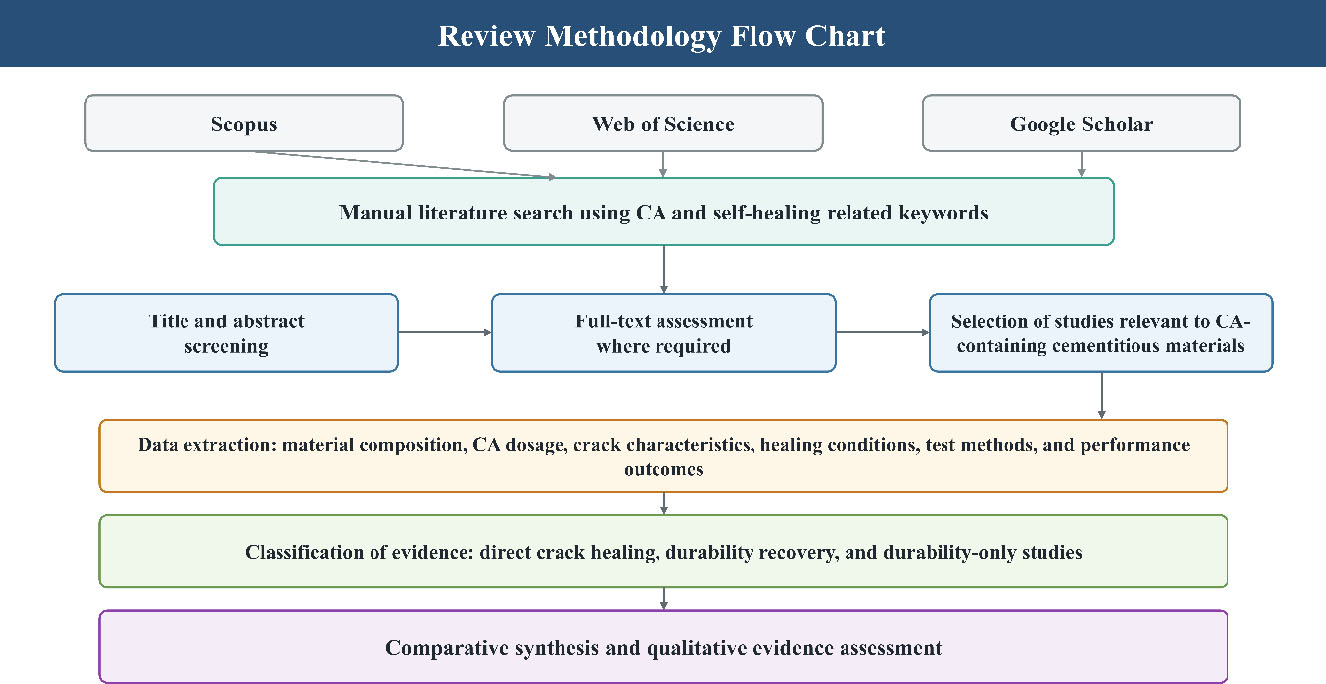
Literature search, screening, classification, and evidence-synthesis workflow.
3. EXPERIMENTAL METHODOLOGIES FOR CEMENT-BASED MIXES WITH CRYSTALLINE ADMIXTURES
Crystalline Admixtures (CAs), also known as Cementitious Capillary Crystalline Waterproofing (CCCW) materials, are dry powders added to concrete to promote self-sealing of cracks. Commercial products (e.g., Xypex, Penetron, Sika) typically contain Portland cement with reactive chemicals such as silicates, aluminates, sulfates, and chlorides that hydrate to form insoluble crystalline deposits [3, 7]. Experimental blends using materials like sodium silicate, sodium carbonate, metakaolin, L-aspartic acid, and nano-silica have also been developed to enhance healing [3, 12]. Typically, CAs are used at about 0.5-3% of the cement weight [13]. For example, commercial CCCW dosages commonly range from 0.8-2.0%, with one study using 0.8% CA in a UHPC mix [14, 15]. The powder form allows easy mixing with cement, and studies show minimal impact on fresh properties while slightly increasing compressive strength (7%) and improving durability [7, 14].
When microcracks form in the presence of moisture, CAs react in place to produce crystalline products that seal cracks. Their components react with water and cement hydration products to form calcium carbonate (calcite/aragonite) and Calcium-Silicate-Hydrate (C-S-H) in crack voids [3]. Additional phases such as ettringite, brucite, and gypsum may form in aggressive environments [3, 16]. Moisture is essential, and cracked specimens are often cured in water or wet-dry cycles [3]. For example, CA-modified cement paste exposed to seawater wet-dry cycles achieved 86% crack closure in 28 days and complete sealing by 42 days, with calcite identified as the main healing product [16]. CAs supply Ca2+ and mineralizers that promote continued hydration and carbonation of Ca(OH)2, enabling sealing of cracks up to 0.3-0.4 mm, beyond the 0.1 mm limit of autogenous healing [3, 16]. The field of CA self-healing is growing rapidly, yet experimental practices differ widely, including mix designs, ways of inducing cracks, and curing conditions. Some studies measure actual crack healing, whereas others assess durability in uncracked samples. That matters because better durability does not guarantee full crack healing. Future work needs consistent testing and separate reporting of crack closure, sealing, and mechanical recovery.
3.1. Mix Design and Specimen Preparation
CA powder is typically mixed with cementitious binders at about 0.5-3% by weight. Some studies also combine CA with additives such as slag, fly ash, metakaolin, or biochar to improve healing and sustainability. Concrete or mortar specimens are cast and cured, then intentionally cracked at a selected age (e.g., 7 or 28 days). Controlled cracks, usually around 0.1-0.3 mm wide, are commonly produced using three-point bending or direct splitting while keeping the specimens intact [16]. The mix design of CA-modified cementitious materials strongly affects healing performance. Differences in cement type, w/b ratio, CA dosage, SCMs, fibers, SAPs, biochar, and other additives can alter hydration, cracking, moisture transport, and healing-product formation. Therefore, CA effectiveness should be judged within the whole material system, not by the admixture alone.
3.2. Crack Induction and Healing Conditions
After cracking, specimens are exposed to curing conditions that promote healing. Common methods include water immersion, alkaline solutions such as Ca(OH)2, or wet-dry cycles to simulate real environments [7, 16]. Accelerated conditions, including chlorinated or sulfate solutions and freeze-thaw cycles, are also used to assess performance under severe exposure [14, 16]. Studies generally show that wet-dry cycles provide the most effective healing, while freeze-thaw without sufficient moisture limits recovery [7]. For example, Cappellesso et al. reported that CA-modified UHPC maintained healing during repeated freeze-thaw cycles with de-icing salts, whereas unmodified mixes deteriorated [14]. Crack induction and healing conditions strongly influence CA-based self-healing results. Laboratory studies often use controlled crack widths and favorable curing, such as water immersion or wet-dry cycles, which enhance hydration and crystal formation. However, real structures are subject to variable moisture, aggressive ions, freeze-thaw cycles, carbonation, and repeated loading. Therefore, lab-based healing results should be interpreted carefully, and studies should focus more on realistic exposure conditions.
3.3. Evaluation Techniques
Various methods are used to evaluate self-healing. Crack closure is commonly measured using optical microscopy and image analysis, where high-resolution crack images are converted to binary images to calculate reductions in crack width or area [16]. Healing efficiency is often expressed as a crack-closure ratio (%). In addition, permeability and sorptivity tests, such as water flow, capillary absorption, and rapid chloride penetration, are performed before and after healing to assess improvements in water tightness [17, 18]. For additional self-healing evaluation techniques, see Fig. (5). Although optical microscopy and image analysis are commonly used to measure crack closure, visible sealing at the surface should not be considered complete proof of self-healing. In many cases, a crack may appear closed from the outside, while the inner crack path may still remain partly connected and allow water or aggressive ions to pass through. Therefore, surface crack closure needs to be supported by functional durability tests, such as water permeability, sorptivity, chloride penetration, and microstructural observations. This distinction is especially important for crystalline admixture-based systems, because their most reliable benefit is often the recovery of water-tightness rather than full mechanical recovery. As a result, future studies should avoid judging healing performance only from surface images and should combine visual, transport, mechanical, and microstructural evidence to provide a more realistic evaluation of CA-induced self-healing. For a detailed discussion, see Section 4.1.
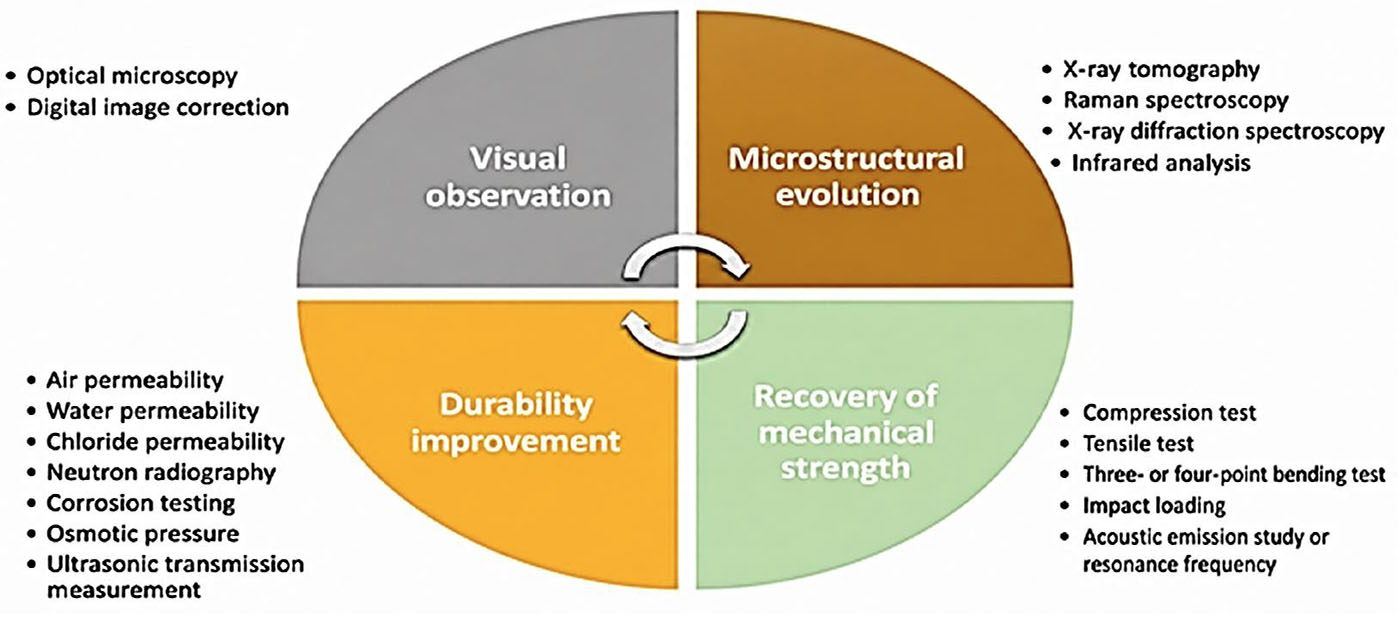
Methods for evaluating self-healing performance in concrete (adopted from [21]).
3.4. Mechanical Recovery
Mechanical recovery is evaluated by retesting the strength of cracked specimens, which are reloaded in compression or flexure to measure regained load capacity. Many studies report residual compressive strength after healing. For example, a mortar mix with 4% CA (+ SAP) recovered 94-95% of its original compressive strength after 28 days of healing [19]. Mechanical recovery in CA-based self-healing systems is often inconsistent. Although crystalline admixtures can seal small cracks and reduce permeability, strength, stiffness, and load-bearing recovery are usually partial and depend on crack width, fibers, healing time, and curing conditions. Therefore, CA-based healing should not be considered structural restoration unless mechanical recovery is directly confirmed through repeated loading or re-cracking tests.
3.5. Microscopic and Chemical Analyses
To supplement these tests, SEM/EDS and XRD identify healing phases (e.g., calcite, ettringite, C-S-H) within healed cracks [12, 16]. Mercury porosimetry or nitrogen adsorption (BET) shows reductions in porosity/ densification after healing [12].
Some studies also employ X-ray CT or neutron imaging to observe crack filling in situ. In summary, key performance indicators include crack closure percentage, permeability reduction, and strength recovery [16, 20]. Microscopic and chemical analyses can identify healing products such as calcium carbonate, C-S-H, ettringite, and other crystalline phases, but their presence does not necessarily confirm full crack sealing or durability recovery. Visible crystal formation may occur while transport pathways remain. Therefore, microstructural evidence should be supported by transport and mechanical tests to confirm functional healing. For a detailed discussion, see Section 4.5.
3.6. Modeling and Theoretical Studies
The Finite Element Method (FEM) is the primary tool for solving coupled problems of transient heat transfer and stress analysis; however, it is characterized by high sensitivity to input parameters and computational complexity [22]. Modeling of CA-induced autogenous self-healing is still limited, with most studies addressing general self-healing cement systems rather than CA-specific reactions. A micromechanics-based constitutive model has been developed to represent time-dependent healing and validated using CA mortar experiments [23]. Other approaches include finite-element simulations of healing beams and image-based analysis. Artificial neural networks and genetic algorithms have also been used to predict healing rates from experimental data [24]. Many models introduce healing terms, such as CaCO3 precipitation or damage-healing cycles, within continuum frameworks. However, standardized predictive models for CA systems remain an ongoing research challenge (Fig. 5). Current models explain self-healing behavior, but CA-specific prediction is still limited. Most focus on general crack closure or damage recovery, not CA reactions and moisture-dependent healing. New models should link CA mechanisms with crack geometry, moisture transport, healing products, and durability recovery for practical design.
4. SUMMARY OF PREVIOUS RESEARCH ON SELF-HEALING CEMENTITIOUS MATERIALS INCORPORATING CRYSTALLINE ADMIXTURES
To provide a clear and comprehensive overview of the last two decades of research, the following Table 1 summarizes key studies on crystalline admixtures. The table is organized to allow for easy comparison of mix designs, commercially available CAs, synergistic combinations, testing protocols, and most importantly, the key performance findings (results) related to crack healing and durability. This table summarizes the main experimental studies on crystalline admixture-based self-healing, but the results should not be read as directly equivalent evidence. Some studies investigate actual crack healing in pre-cracked specimens, while others focus on water permeability, chloride resistance, strength development, or durability improvement in uncracked concrete. In addition, the reported crack widths, healing durations, exposure conditions, and testing methods vary widely. Therefore, the table is used not only to list previous studies but also to compare the type and strength of evidence provided by each study.
The studies summarized in the table above show that crystalline admixtures generally improve water-tightness and support the healing of small cracks, especially when sufficient moisture is available. However, the evidence is not uniform across all studies. Reliable healing is most often reported for relatively small cracks, while wider cracks usually require longer healing periods, favorable curing conditions, or additional crack-control materials such as fibers, SCMs, SAPs, or biochar. The table also shows that some studies report strong durability improvements without directly proving crack healing. This indicates that CA technology is mature as a waterproofing and durability-enhancing approach, but its role as a reliable self-healing system still depends on crack width control, moisture availability, and proper evaluation methods.
4.1. Key Insights Derived from Table 1: Cross-Study Interpretation of 80 Investigations on Crystalline Admixtures
Table 1 summarizes 80 experimental and field studies examining the performance of Crystalline Admixtures (CAs) in cement-based materials. Rather than focusing only on individual results, the studies were compared to identify recurring trends, consistent findings, and important contradictions across the literature. The most consistently reported variables were CA dosage, initial crack width, healing condition, and healing duration, although their reporting formats varied considerably among studies. Percentage-based CA dosages were typically concentrated around 0.8-2.0% by cement or binder mass, while controlled crack widths were predominantly within the 0.1-0.3 mm range. Healing periods ranged from several days to several months, with some studies extending to one year or longer. A single statistical average of healing performance was not considered appropriate because the studies reported different outcomes, including crack-closure percentage, water-flow or permeability reduction, water-penetration depth, mechanical recovery, and chloride-related durability indicators. The cross-study interpretation was therefore based on reported ranges, recurring patterns, and comparable groups of studies rather than pooling non-equivalent performance measures into a single statistical value. This approach allows the main performance boundaries and sources of variability in CA-based self-healing to be identified more clearly.
4.1.1. Dominant Crack Width Range for Reliable Self-Healing
One of the clearest trends emerging from Table 1 is the strong dependency of CA-induced healing on initial crack width. Across the majority of mechanically induced crack studies, the target crack width lies between 0.1 and 0.3 mm, including investigations by Buller et al. [26], Ziegler et al. [28], Azarsa et al. [55], Wang et al. [54], Manhanga et al. [51]Within this range, crack closure rates commonly exceed 70-90% under favorable curing conditions.
Cracks smaller than approximately 0.15 mm frequently achieve near-complete sealing, particularly under continuous water exposure [51, 55]. In contrast, crack widths approaching or exceeding 0.4 mm exhibit more variable outcomes. While some studies report successful closure near this limit (e.g., Wang et al. [54] and Manhanga et al. [51]), others indicate incomplete or slower sealing for wider cracks [44].
Studies that did not induce controlled cracks (e.g., Pazderka and Hájková [30] and Suwondo et al. [56, 57]) focused instead on bulk permeability, making crack-width-dependent comparison impossible. This variability in crack induction methodology highlights the need for standardized crack width protocols. Overall, Table 1 suggests that 0.3 mm represents a practical and consistent upper threshold for reliable CA-induced crack healing, while performance beyond this range remains condition-dependent.
4.1.2. Critical Role of Moisture and Exposure Conditions
The healing activation mechanism of crystalline admixtures is strongly moisture-dependent, and Table 1 above confirms this across multiple studies. Continuous water immersion consistently yields high healing efficiency [101] Wet-dry cycling environments, such as those used by Ziegler et al. [28] and Dao et al. [43], also stimulate healing by promoting repeated dissolution-precipitation processes.
Interestingly, marine and seawater environments sometimes enhance mineral formation due to magnesium participation in brucite and carbonate precipitation [102]. However, aggressive chemical environments (e.g., sulfates or acids) present mixed outcomes. Suwondo et al. [56] reported improved resistance to acidic attack, while Dao et al. [43] found negligible improvement in chloride diffusion performance. Dry air exposure or limited moisture conditions typically result in minimal crack sealing, reinforcing the conclusion that water availability is the primary activation trigger for CA-based healing systems.
4.1.3. Optimal Dosage Range and Performance Stability
A clear dosage trend emerges from the above table. Most effective studies employed CA dosages between 0.8% and 2.0% by cement mass [27]. Higher dosages (≥3%) were investigated in some cases, such as Weng and Cheng [36] and Wang et al. [54], with mixed outcomes. While permeability reduction improved, workability and early-age behavior were sometimes negatively affected. Feng et al. [39] reported increased shrinkage stress and earlier cracking potential at higher CA contents. Conversely, very low dosages (<0.5%) tended to show limited or inconsistent performance gains.
Thus, Table 1 indicates that 1-2% CA content appears to provide a balance between effective healing and acceptable mechanical performance, although optimal dosage may vary depending on mix design and exposure environment.
4.1.4. Synergistic Effects with Supplementary Materials and Fibers
A recurring theme across multiple investigations is the synergistic interaction between CAs and other material modifications. Studies combining CA with fly ash, slag, silica fume, or metakaolin (e.g., Hodul et al. [32] and De Souza and Sanchez [48]) reported enhanced matrix densification and improved long-term durability. The combination of CA with fibers (e.g., Ferrara et al. [27] and Escoffres et al. [46]) significantly improved crack distribution by producing multiple fine cracks instead of isolated wider cracks, thereby enhancing healing reliability.
Biochar-modified systems (Lin et al. [49]) and geopolymer systems (Sidhu and Kumar [58]) further suggest that CA technology can extend beyond conventional OPC-based matrices. These results indicate that CA effectiveness is improved when combined with crack-width control strategies, particularly fiber reinforcement and SCM incorporation.
4.1.5. Permeability Reduction and Durability Enhancement
Even in studies without induced cracks, crystalline admixtures consistently improved water tightness. Substantial reductions in water penetration depth were reported by Pazderka and Hájková [30], Ndoj et al. [60], Suwondo et al. [56, 57], and Petrucci and Hastenpflug [52]. Chloride penetration resistance improved in several cases (Azarsa et al. [55]; Hodul et al. [32]), although this improvement was not consistently observed (Dao et al. [43]; Antón et al. [45].
These inconsistencies may arise from differences in test methods (RCPT vs. long-term diffusion), crack presence, curing regimes, and admixture chemistry. Notably, studies evaluating cracked specimens often report stronger permeability recovery than those testing intact specimens only. Thus, while CA systems reliably reduce water permeability, their influence on ionic transport under standardized chloride exposure remains partially method-dependent.
4.1.6. Microstructural Mechanisms Confirmed Across Studies
Microstructural analyses across Table 1 consistently identify calcium carbonate (calcite or aragonite) and secondary C-S-H gel as primary healing products, as shown in Azarsa et al. [42], Wang et al. [54], Manhanga et al. [51], and De Souza and Sanchez [48]. In marine environments, brucite formation has been reported [54], indicating interaction between magnesium ions and hydration products. SEM and XRD findings confirm densification of pore structure and crack-void filling across most CA-modified systems. While the healing products are generally agreed upon, their formation processes and long-term stability still need further study.
4.1.7. Methodological Variability and Standardization Challenges
Table 1 reveals significant methodological diversity:
- Crack widths vary widely (or are unreported in several studies).
- Healing durations range from days to over one year.
- Some studies evaluate re-cracking cycles (Xi and Ferrara [44], while others assess single healing events.
- Some investigations focus only on uncracked bulk specimens (e.g [56, 57].
These differences make it hard to directly compare results and indicate that there is no standard method for evaluating self-healing yet.
The comparative evidence indicates that CA-assisted self-healing is governed by the interaction between the healing mechanism and the conditions surrounding the crack. Moisture activates continued hydration, dissolution and transport of reactive species, and precipitation of healing products within cracks and pores. The extent of recovery is subsequently influenced by initial crack width, CA dosage, binder composition, healing duration, and exposure environment. These interacting factors determine whether the response remains limited to visible surface sealing or progresses into functional recovery of water-tightness, durability, and, in some cases, mechanical properties. Based on the reviewed studies, the conceptual framework presented in Figs. (6 and 7a and b) brings these relationships together and also provides practical guidance for CA application.
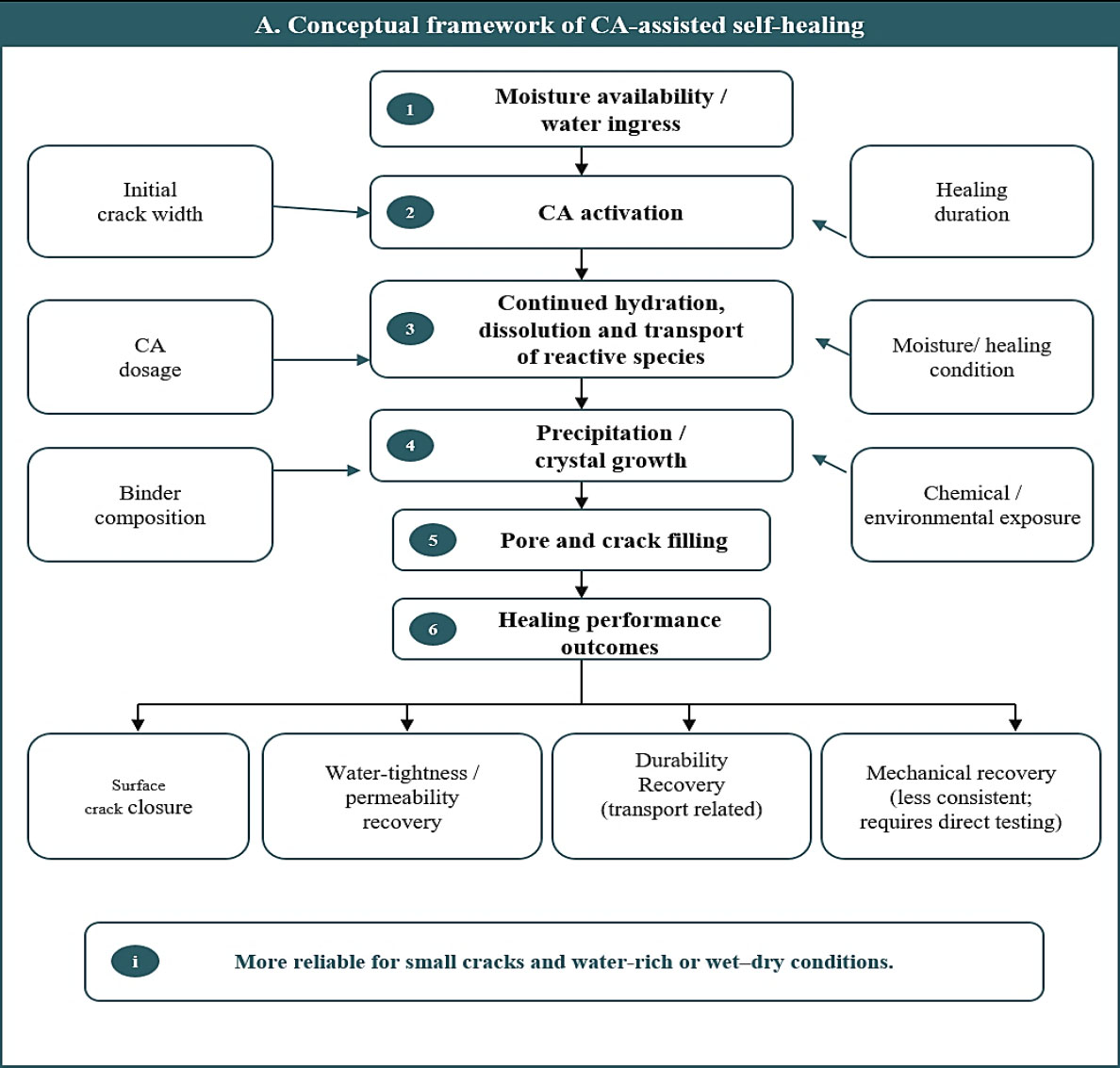
Conceptual framework of CA-assisted self-healing.
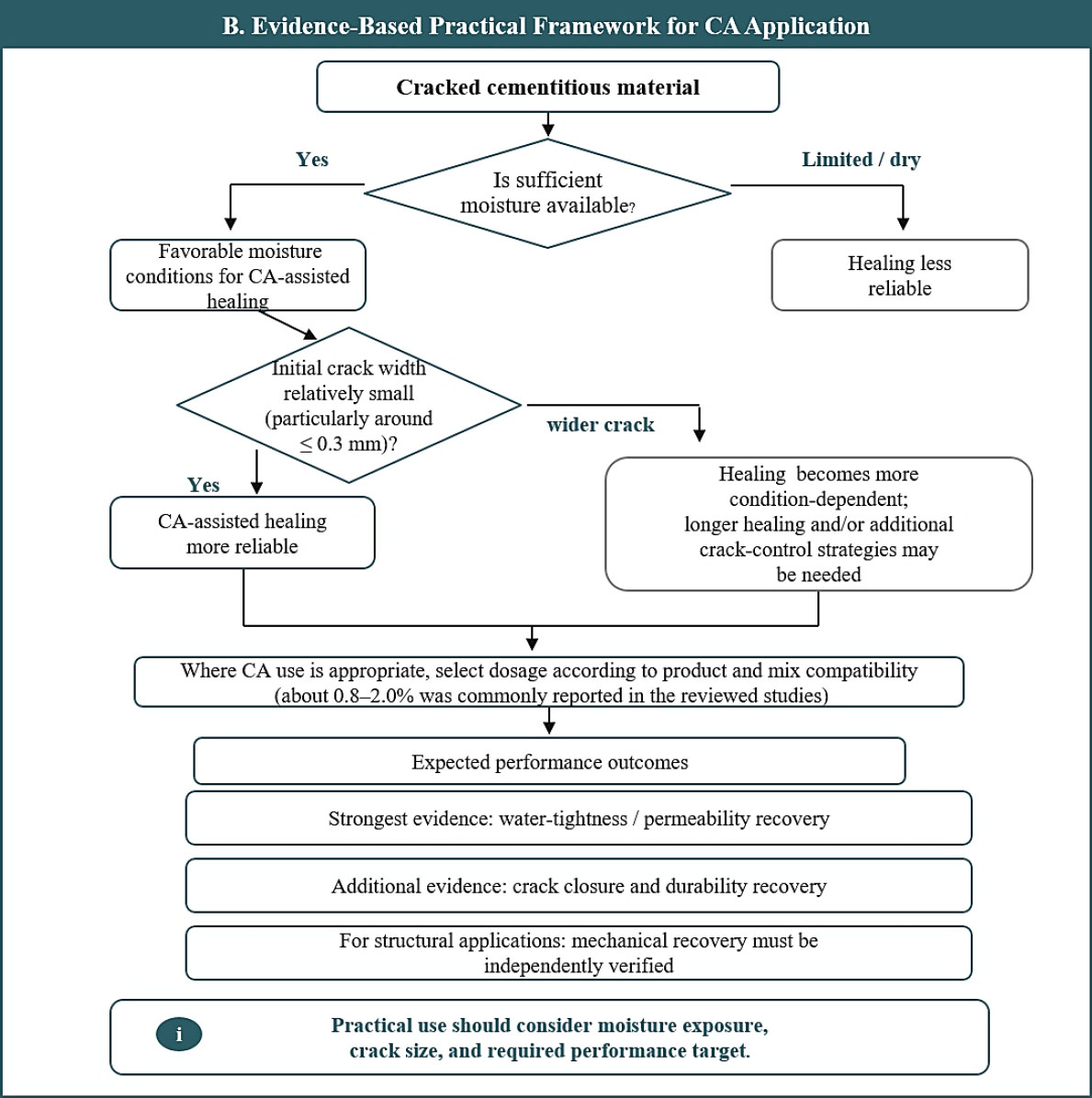
Practical framework for CA application.
The evidence is most consistent for relatively small cracks under water-rich or wet-dry conditions, while performance becomes more variable as crack width increases or moisture availability decreases. Water-tightness and permeability recovery are generally more consistently reported than complete mechanical recovery; therefore, structural recovery should be verified independently when it is required for a particular application.
4.1.8. Overall Technical Assessment based on Table 1
Collectively, the 80 reviewed studies demonstrate that crystalline admixtures:
- Reliably enhance water-tightness.
- Achieve consistent healing for cracks ≤0.3 mm under moist conditions.
- Exhibit improved performance when combined with fibers or SCMs.
- Show variable chloride resistance depending on methodology.
- Require moisture for activation.
- Lack long-term (>10 years) standardized field validation.
Therefore, CA technology can be considered mature for waterproofing and durability enhancement, while its application in structural crack-healing design remains partially dependent on environmental and crack-control conditions. The main insight from the comparative analysis is that CA-based self-healing should be evaluated through a performance boundary rather than a simple “healed or not healed” conclusion. The effectiveness of crystalline admixtures depends on the interaction between crack width, moisture condition, binder chemistry, exposure environment, and evaluation method. Small cracks under wet or wet-dry conditions show the most consistent healing response, while larger cracks and dry environments produce less predictable results. Therefore, new studies should report not only the final healing percentage, but also the initial crack-width distribution, healing environment, exposure duration, and the difference between surface closure and internal sealing. This would make the literature more comparable and help define the realistic application range of crystalline admixtures.
5. EVALUATION METHODS: SELF-HEALING CEMENTITIOUS MATERIALS WITH CRYSTALLINE ADMIXTURES
Self-healing cementitious materials (mortar, concrete, UHPC, etc.) incorporate agents like Crystalline Admixtures (CAs) that promote autogenous crack sealing by forming new mineral precipitates. Research over the past years has developed many experimental and computational methods to quantify the extent to which cracks heal and properties recover. Experiments measure crack closure and reductions in permeability, as well as recovery of strength or stiffness, using both macro and micro‐scale techniques. For example, the formation of needle-like Calcium-Silicate Hydrate (C-S-H) and CaCO3 in cracks, a known CA mechanism [103] can be detected by SEM/EDS or XRD. Imaging methods (optical microscopy, digital imaging or micro-CT) directly observe crack filling [19, 104]. Water permeability or absorption tests through cracked specimens quantify durability recovery [46, 105]. Mechanical tests (compression, tension, or flexure) are performed before and after healing to measure the recovery of strength or stiffness. For detail explanation, see Fig. (4) [19]. Computationally, continuum finite-element models, diffusion-reaction simulations, and data-driven models have been used to predict healing. The following sections summarize these methods in detail. The diverse evaluation methods in CA-based self-healing research make comparisons among studies difficult. Crack closure, permeability, chloride resistance, strength recovery, and microstructural evidence each show different healing aspects. Therefore, new studies should combine visual, transport, mechanical, and microstructural tests to determine whether crystalline admixtures only seal cracks or truly restore material performance.
5.1. Crack Closure and Sealing Measurements
Crack closure is a key indicator of self-healing performance in cementitious materials. Many studies monitor crack width over time using optical microscopy and digital image analysis. For instance, Zhang et al. (2023) [19] captured crack images at 0, 7, 28, and 90 days using a 3D optical microscope to quantify crack narrowing in Crystalline Admixture (CA)-modified mortar. Image-processing techniques, such as binarization of crack images, are often used to improve measurement accuracy. Similarly, stereomicroscopy and digital imaging have been applied to track crack closure; for example, Xi and Ferrara (2024) photographed and measured crack faces in UHPC under different curing conditions, showing gradual crack sealing during the healing period [44]. More recently, high-resolution micro-CT has enabled three-dimensional analysis of crack networks before and after healing. Ajitanshu et al. (2025) used X-ray microtomography to capture pore and crack geometry in healed concrete, with image analysis providing crack-width and pore-structure data that supported a FEM healing model [104].
In many studies, healing performance is quantified using the ratio of healed crack width to the original crack width. Plain concrete generally exhibits limited healing (<20%), whereas CA-modified systems “often combined with SAP or SCMs” can achieve nearly complete crack sealing over time, with reported healing efficiencies of about 86% within 28 days and up to 94-99% after longer curing periods. Image-based observations further reveal dense white mineral deposits filling the cracks, confirming the formation of healing products within the crack volume [16, 19]. CA-assisted crack sealing is associated with moisture-triggered formation and growth of crystalline healing products within the crack and adjacent pore structure (Fig. 8). As these products progressively accumulate, the open crack pathway is reduced. This mechanism is consistent with the time-dependent surface observations shown in Fig. (9), where a CA-containing specimen with an initial crack width of approximately 170.73 μm exhibited partial closure after 7 days and substantial surface sealing after 28 days. Together, these figures illustrate the relationship between crystalline product formation and the progressive development of crack closure with healing time (Fig. 10).
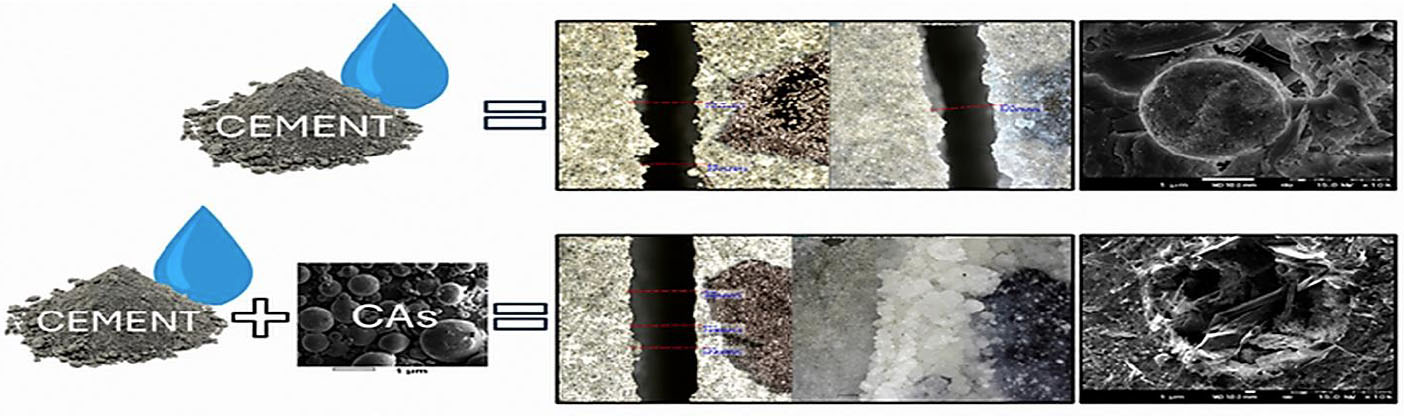
Crack closure with CAs and without CAs (adopted from [13]).
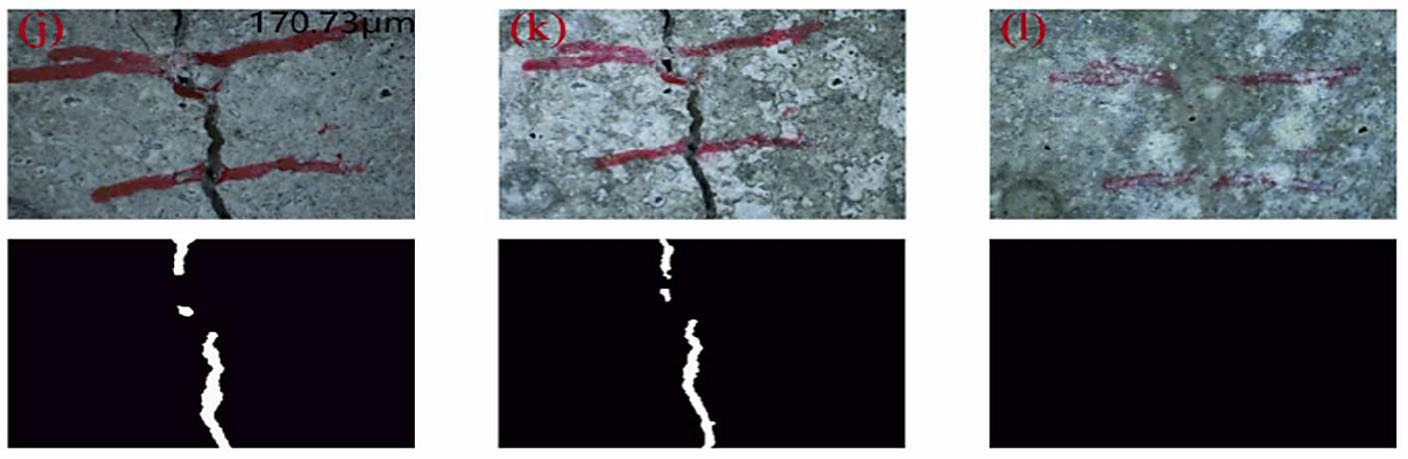
Time-dependent crack healing of a CA-containing specimen at 0, 7, and 28 days (adapted from [101]).
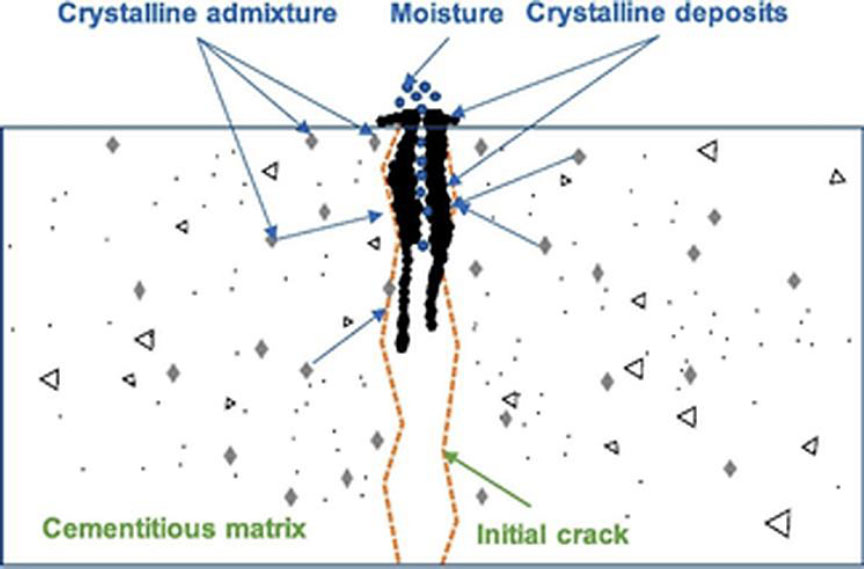
CA-induced crystalline deposits for crack sealing (adapted from [7]).
5.2. Permeability and Durability Tests
Reduced permeability after healing is another key indicator of self-healing. Water permeability tests on cracked specimens are commonly used, where water flow through the crack is measured. Because no standard method exists, various procedures are applied, including one-sided absorption, falling-head (Fig. 11), and accelerated chloride penetration tests. Shin et al. (2021) identified water permeability testing as a primary durability indicator, noting that healed concrete often shows significantly reduced flow after sealing [105].
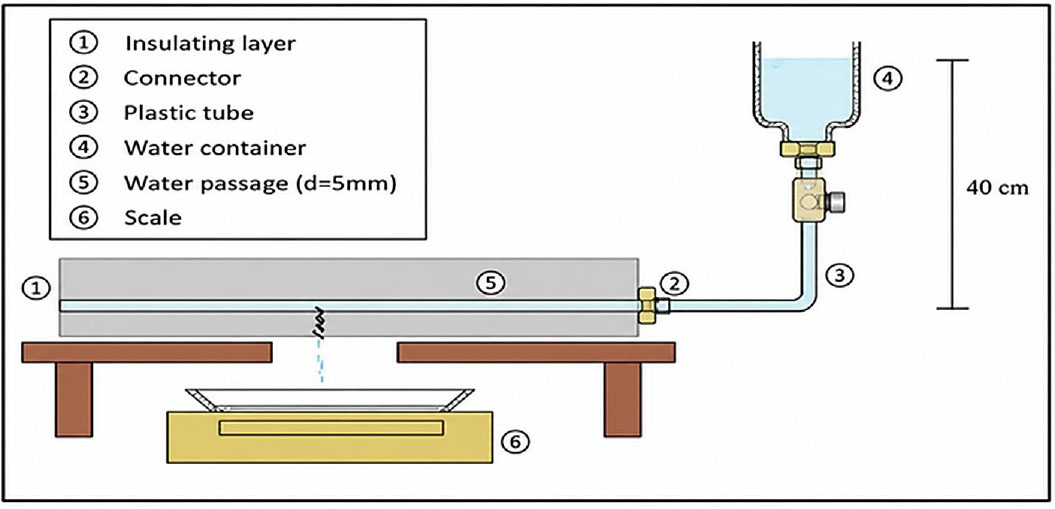
Crack-Water Permeability test for crack specimens (Falling Head) (Adopted from [106]).
For example, Zhang et al. sealed one side of a cracked specimen with epoxy and measured water absorption from the other side, finding that CA-treated samples allowed much less water than controls, indicating permeability recovery [19]. Overall, CAs significantly improve water-tightness in cracked concrete. Water flow and capillary absorption tests show large permeability reductions, and CA + SAP systems can nearly eliminate water flow in pre-cracked specimens [17]. Modern reviews also report reduced sorptivity and chloride diffusion in CA-modified mixes [7, 18], with one study showing that CA-containing cement composites halved rapid chloride penetration current and chloride diffusion depth compared with plain concrete. Improved impermeability has also been observed under aggressive curing conditions, such as 5% Na2SO4 or simulated seawater exposure [16, 18]. Chloride diffusion tests (NT BUILD 492) also show reduced chloride penetration in healed CA-modified mixes and are often combined with sorptivity or capillary absorption tests. Overall, these transport tests quantify how effectively CAs block fluid pathways, though standardized protocols are still lacking [32].
5.3. Mechanical Recovery Tests
Self-healing can also be evaluated by the recovery of mechanical strength or stiffness. Typically, specimens are pre-cracked (e.g., in tension or flexure), allowed to heal, and then retested to determine a strength recovery index. Zhelyazov (2022) reported that crack sealing can partially or fully restore compressive or tensile strength [107]. Experimental studies frequently show significant recovery in CA-modified systems. For example, Cappellesso et al. observed a 7% higher compressive strength in a CA-UHPC mix even before cracking [14], while Zhang et al. reported that CA addition increased compressive strength by about 15-28% after 28-56 days compared with the control mortar. In healed mortars, 2-4% CA can achieve about 80-95% strength recovery, with one study reporting 94.5% recovery when 4% CA was combined with SAP [19]. Similar trends were observed in UHPC beams pre-cracked in a splitting-tensile setup, where significant stiffness recovery after healing was detected using Ultrasonic Pulse Velocity (UPV) and repeated flexural tests [44]. These improvements are mainly attributed to crack-filling hydration products such as C-S-H that rebond crack surfaces. In some cases, combining crystalline admixtures with superabsorbent polymers produces a synergistic effect: Wu et al. (2022) showed that CA promotes dense precipitates that enhance flexural recovery, while SAP expansion fills larger gaps, together producing an apparent strength recovery exceeding 100% due to internal curing [108].
5.4. Micro and Nano Scale Characterization
To investigate healing mechanisms, crack surfaces are commonly analyzed using microscopy and spectroscopy techniques. SEM-EDS and XRD identify precipitated crystals in healed cracks. For example, Zhang et al. (2023) showed that crystalline admixtures form dense, needle-like C-S-H structures that fill microcracks, with CA + SAP mortar exhibiting nearly complete crack bridging compared with partial filling in controls [19]. In CA systems, early-stage cracks are often sealed by calcite formed from the reaction of Ca2+ with CO2, followed by the formation of C-S-H and sometimes ettringite at later stages [12, 19]. Pore structure analyses further indicate that CA filling significantly reduces total porosity. For instance, Ren et al. (2024) reported that an optimized CA blend (L-aspartic acid + Na2SiO3 + nano-silica) reduced pore volume and densified the matrix after healing [12].
5.5. Novel Crack-Induction Protocols
Achieving reproducible crack patterns remains challenging, so several studies propose standardized cracking methods. Medeiros and Di Sarno (2024) developed mechanical rigs (nylon-string split, wedge, and plate methods) to produce consistent cracks and evaluate healing using water permeability tests [109]. Similarly, notched bending specimens and specialized setups such as ring or plate tests are used to create controlled cracks, improving the reliability of permeability testing and mechanical retesting after healing.
5.6. Standardization and Specification Frameworks
When it comes to standards, there isn't a specific ASTM test just for crystalline admixtures. However, guidelines such as ACI 212.3R classify them as Permeability-Reducing Admixtures (PRAs) [103, 110]. To evaluate their performance, researchers typically rely on a combination of standard and specialized tests. For instance, water permeability is often measured under a pressure of 0.5 MPa for 72 hours, while chloride resistance is measured using methods similar to ASTM C1202 [103].
However, although suitable methods are available for testing strength and durability, there's still no universal standard for measuring self-healing. As Ravitheja et al. highlight, every research group tends to use its own approach, which makes it nearly impossible to compare results side by side [110]. This variation in testing methods highlights the need for unified testing protocols that control for factors such as admixture type, mix design, and environmental conditions [103].
In practice, the evaluation of crystalline admixtures typically relies on conventional strength and durability tests, complemented by specialized methods that examine permeability and crack-healing behavior. While a standardized procedure for measuring self-healing has yet to be established, existing mechanical, permeability, and microstructural tests still provide clear evidence of the ability of crystalline admixtures to seal cracks. As the use of these materials continues to grow, the development of unified standards will become increasingly important to enable consistent comparison among different products and research studies. Further details of tests used for evaluation of self-healing are summarized in below Table 2 below.
| Test / Standard | Property Measured | Typical CA Effect |
|---|---|---|
| ASTM C39 / EN 12390-3 | Compressive strength | Neutral to slight increase; no degradation compared to controls [7, 103] |
| ASTM C496 / C78 | Splitting tensile and flexural strength | No reduction [22] |
| ASTM C805 / C597 | Non-destructive (rebound hammer, UPV) | Tracks durability trends; confirms strength retention during cycles [75] |
| DIN 1048 / EN 12390-8 | Water penetration under pressure | Depth reduced to 15 mm; sometimes “nil” reported [30] |
| ASTM C642 / C1585 | Water absorption and capillary sorptivity | 43% lower absorption [83] |
| ASTM E96 / ISO 12572 | Water vapor transmission | Higher vapor resistance factor (µ = 85 vs. 71 control) [30] |
| ASTM C1202 / NT Build 492 | Chloride permeability/migration | Lower charge passed; reduced chloride ingress [20] |
| AS 2350.13 | Free shrinkage (prism length change) | Lower shrinkage observed [84] |
| ASTM C1579 | Restrained/plastic shrinkage cracking | Delayed cracking, fewer/narrower cracks [85] |
| ASTM C666 / C215 | Freeze-thaw resistance, dynamic modulus | Higher DF and RDME retention (e.g., 87% vs. 62%) [75] |
| ASTM C672 | Surface scaling with de-icing salts | Lower mass loss and surface damage [75] |
| ASTM C1012 | Sulfate resistance | Indications of reduced expansion; limited data. [75] |
| Custom setups (e.g. RILEM) | Self-healing (water flow, crack closure, etc.) | 99-100% sealing ratio; cracks up to 0.3 mm fully healed in 4-8 weeks [75] |
6. COMPUTATIONAL MODELING AND SIMULATION:
Computational modeling complements experimental studies by simulating crack evolution, moisture transport, and the recovery of material properties during self-healing. Current approaches include finite-element damage-healing models, coupled diffusion-reaction frameworks, and data-driven methods. These models help clarify how crack characteristics, moisture availability, and healing processes influence the recovery of cementitious materials.
6.1. Continuum Damage Finite Element Models
Numerical models are used to predict the influence of self-healing on structural response, commonly through Finite Element Analysis (FEA) with damage-healing constitutive laws. Zhelyazov (2022) developed a continuum damage model in ANSYS, in which concrete behaves as a damage-softening material and healing is simulated by resetting the damage variable to zero after crack formation [107]. Figure 12 shows a flowchart of the employed numerical procedure. In this model, elements with damage beyond a threshold are “healed” (damage variable set to zero) at the start of a simulated healing phase. The FE code then reloads the specimen; crack-sealed regions regain stiffness and carry load again. Zhelyazov showed (Fig. 13) that healed specimens exhibit a renewed stress-strain curve: after the original peak (grey line), the healed curve (black line) resumes increasing stress with further loading. Other approaches combine damage mechanics with transport processes. Liu (2026) developed a 2D FEM model in FEniCSx coupling damage with moisture diffusion, where water transport following Fick’s law activates cementitious healing by reducing damage according to local moisture and cement availability.
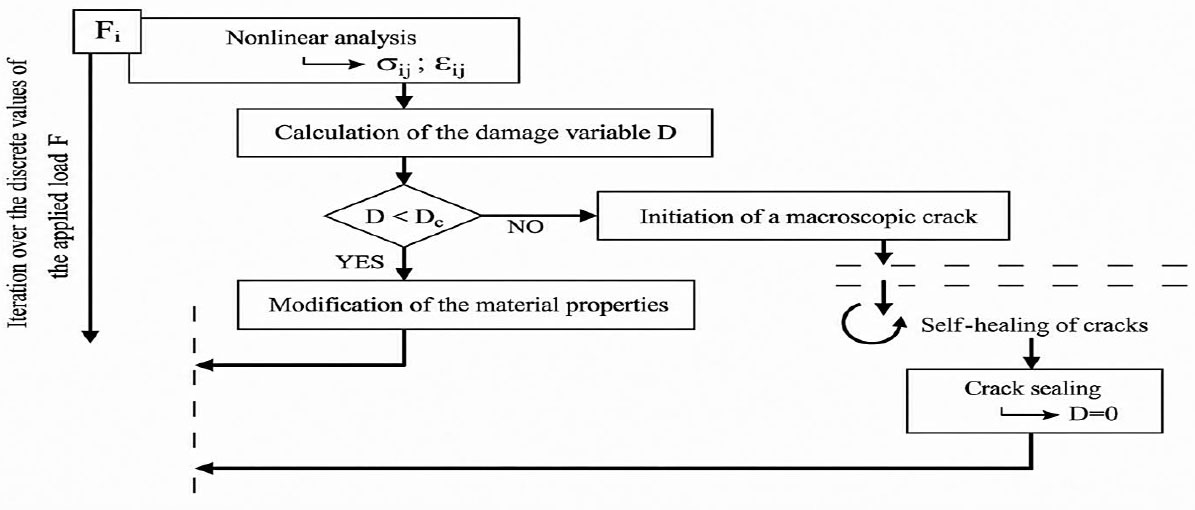
Flowchart of a continuum damage-healing algorithm used in finite element simulation (adopted from [107]]).
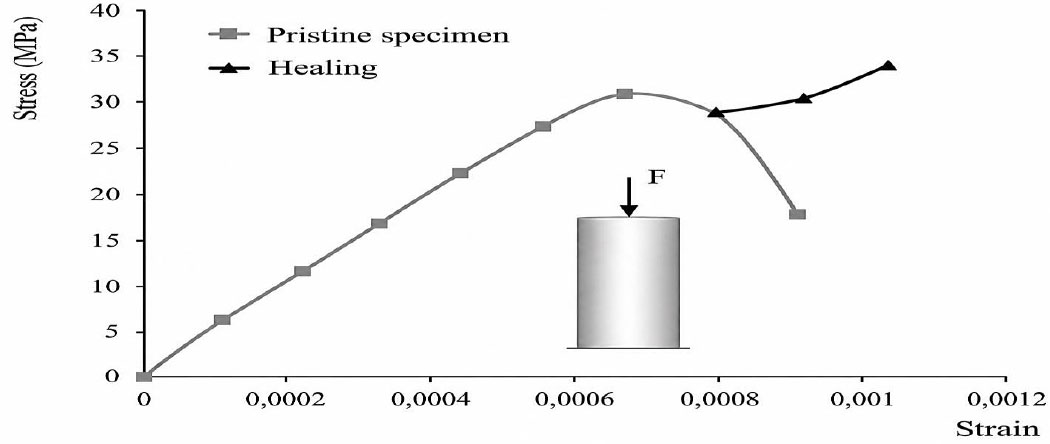
(adapted from [107]).
The model predicts healing time and spatial healing patterns and incorporates machine learning to estimate healing time based on crack characteristics [111]. Overall, such FEM models simulate crack closure and the recovery of mechanical properties such as stiffness and load capacity.
Stress-strain response of a standard cylindrical concrete specimen loaded in compression and then subjected to a self-healing of cracks. The numerically obtained stress-strain relationship for the pristine specimen is shown in grey and the action of the healing agent in black (adapted from [107]).
6.2. Micromechanical and Rate-Dependent Models
Some models operate at smaller scales. Sayadi et al. (2024) developed a 3D micromechanical constitutive model for cementitious healing that allows overlapping damage and healing while maintaining thermodynamic consistency. Implemented in a nonlinear 3D FE code, it was validated through single-element and notched-beam simulations against experiments. One validation used concrete with crystalline admixture, where the model accurately reproduced the load-displacement response and healing recovery of a notched beam [23].
6.3. Multiphysics and Microstructure-based Simulations
Some modeling approaches explicitly simulate diffusion-precipitation processes. Finite-element frameworks combining micro-CT-based geometry with reactive transport models have been used to simulate ion transport and CaCO3 precipitation in cracks [104]. Although the approach was applied to microbial healing in that study, the approach demonstrates how microstructural FEMs can predict healing processes. More generally, reaction-diffusion models simulate the transport of calcium ions into cracks and the precipitation of solid phases over time, enabling the prediction of pore filling under different humidity and ion-supply conditions.
6.4. Data-Driven and Machine Learning Methods
Machine learning has recently been used to predict self-healing performance. Using experimental datasets such as crack images and flow measurements, AI models can estimate healing outcomes. For example, Althoey et al. (2022) proposed a machine learning-based computational approach for detecting crack widths [112]. Jakubowski and Tomczak also proposed a deep-learning “metasensor” that analyzes crack images to measure width and healing progress [113]. These data-driven models enable rapid estimation of healing performance and support mix design. Although not yet standardized, AI approaches can complement experimental testing by identifying key variables affecting healing, such as crack orientation influencing healing time [111].
Recent research applies a wide range of methods to evaluate self-healing in cementitious materials with crystalline admixtures. Experimental techniques include macroscale crack monitoring (optical microscopy, image analysis, mechanical tests) and microscale characterization (SEM and XRD of healing products and micro-CT of crack geometry). Key indicators include crack closure, permeability reduction, and strength recovery. Computational approaches involve continuum FE models, diffusion-reaction simulations, and data-driven predictions. These tools help predict healing kinetics and the influence of factors such as crack size and exposure conditions. Despite these advances, many studies emphasize the need for standardized testing protocols to enable reliable comparison of results.
7. RESEARCH GAPS AND FUTURE DIRECTION
The reviewed studies show that crystalline admixtures can improve water-tightness, reduce permeability, and support crack sealing in cement-based materials. However, their self-healing performance is still not fully predictable because it depends on crack width, moisture availability, CA dosage, binder composition, exposure condition, and evaluation method. Future studies may therefore move beyond proving that CAs can heal cracks and focus on defining the conditions under which they work reliably.
A major gap is the absence of standardized testing methods. Existing studies use different cracking techniques, healing environments, exposure periods, and evaluation indicators, making direct comparison difficult. Future investigation could adopt a common framework that defines crack-width ranges, healing duration, exposure conditions, and key assessment methods, including crack closure, permeability recovery, mechanical recovery, and microstructural confirmation.
Crack width remains one of the main limitations. CA-based healing is most reliable for small cracks, commonly around 0.1-0.3 mm, while wider cracks show less consistent recovery. Some wider cracks can be partially or successfully sealed, but usually under favorable moisture conditions, longer healing periods, or with fibers and other crack-control materials. Future experimental studies need to report average and maximum crack widths, crack depth, and crack-width distribution to more clearly define the practical healing range of CAs.
Moisture dependency also limits application. Since CAs require water to activate continued hydration, ion transport, and the precipitation of healing products, they are suitable for water-retaining structures, tunnels, basements, marine structures, and hydraulic infrastructure. Their performance in dry or low-moisture environments remains uncertain. Additional investigations can explore moisture-retaining strategies, including SAPs, internal curing agents, porous carriers, lightweight aggregates, biochar, and moisture-retaining SCMs.
Another important issue is the difference between surface crack closure and internal healing. Visible closure from optical microscopy or image analysis does not always mean that the crack is fully sealed internally. At the same time, limited surface closure may still reduce permeability or improve chloride resistance if internal pathways are blocked. Therefore, visual observation is necessary to be combined with permeability, sorptivity, and chloride transport tests, as well as SEM/EDS, XRD, FTIR, or micro-CT analysis.
The literature also needs clearer separation between direct self-healing evidence and durability-only evidence. Studies that induce cracks and measure healing directly provide stronger self-healing evidence, whereas studies on uncracked specimens mainly show waterproofing, matrix densification, or improved durability. These durability-only studies are useful, but they should not be treated as direct proof of crack self-healing. Prospective research needs to classify studies as direct crack-healing studies, durability recovery studies, or durability-only studies.
Mechanical recovery remains less consistent than permeability recovery. Many CA-modified mixtures reduce water flow effectively, but this does not necessarily restore strength, stiffness, or load-bearing capacity. A crack may be sealed enough to limit water movement while still remaining mechanically weak. Further investigations must therefore evaluate mechanical recovery separately using flexural reloading, stiffness recovery, tensile response, compressive recovery, or fracture-energy recovery, especially for structural applications.
Hybrid systems are among the most promising future directions. Fibers can control crack width, SCMs can refine pores, SAPs can provide internal water, expansive agents can help fill cracks, and biochar or nanomaterials can provide nucleation sites for healing products. However, these combinations are not yet fully optimized. Further research are needed to compare CA-only, additive-only, and hybrid mixtures under the same crack width, curing condition, and exposure environment to identify whether improvement comes from CA, the added material, or their interaction.
Chloride resistance also requires further study. Some studies report improved chloride resistance after CA addition, while others show limited improvement. This inconsistency may result from differences in crack condition, curing regime, exposure duration, test method, and CA chemistry. Since chloride ingress is a major cause of reinforcement corrosion, continued research may evaluate chloride transport in both cracked and uncracked specimens using long-term and standardized methods.
CA-specific predictive modeling is still limited. Most current models describe general self-healing rather than the specific reactions of crystalline admixtures. Future models should connect moisture transport, ion diffusion, calcium carbonate or C-S-H precipitation, crack-width reduction, permeability recovery, and mechanical recovery. This requires standardized datasets that include crack width, CA dosage, binder composition, exposure condition, healing duration, and multiple recovery indicators.
The economic benefit of crystalline admixtures is still difficult to assess because most studies focus on healing performance rather than cost. Their use may reduce later repair needs. Information on material price, labor, maintenance, repair access, and life-cycle cost is rarely reported. More complete cost data, considered together with healing and durability performance, are needed to judge whether CA-modified concrete offers a real long-term economic advantage over conventional repair.
The environmental effects of crystalline admixtures are also not well established because most studies do not report sufficient information on raw materials, manufacturing energy, emissions, transportation, or end-of-life impacts. Although CA-based healing may reduce repair needs and extend service life, the available evidence is not enough for a reliable life-cycle comparison with conventional repair methods. Further evaluation combining durability performance with life-cycle assessment is therefore needed to clarify the overall environmental benefit of CA-modified concrete.
Finally, long-term field validation remains insufficient. Most studies are laboratory-based, while real structures experience drying, wetting, loading, carbonation, chloride ingress, sulfate attack, freeze-thaw cycles, and repeated cracking together. Future research should include monitored field applications in tunnels, basements, water tanks, marine structures, bridges, and underground concrete elements, with long-term tracking of crack behavior, leakage, permeability, corrosion risk, and durability recovery. The major research gap is no longer whether crystalline admixtures can contribute to self-healing, because many studies have already shown positive effects under suitable conditions. The more important question is under which conditions this healing can be considered reliable. Current evidence shows that CA performance is strongly affected by crack width, moisture availability, exposure environment, binder composition, admixture dosage, and evaluation method. Therefore, future research should move from simply demonstrating healing toward defining clear performance limits, standardized testing protocols, and practical design criteria. This shift is necessary if crystalline admixtures are to be used confidently in real structures rather than only as promising laboratory materials.
CONCLUSION
This review examined recent experimental research on crystalline admixtures as a self-healing strategy for cement-based materials and highlighted their growing importance in improving the durability of concrete. Overall, the reviewed studies show that crystalline admixtures can promote crack sealing through continued hydration and the precipitation of healing products such as calcium carbonate and additional calcium-silicatehydrate, which fill microcracks and densify the pore structure. In most cases, effective healing is reported for crack widths typically below 0.3-0.4 mm, particularly when sufficient moisture or wet-dry cycles are available to activate the healing process. The comparative evidence also shows that crystalline admixtures are more consistently effective at improving water-tightness and reducing permeability than in restoring full mechanical capacity. Many CA-modified mixtures show reduced water penetration, improve permeability resistance, better durability indicators, and partial mechanical recovery, but strength or stiffness recovery is not always complete. Therefore, CA-based self-healing should be interpreted mainly as a durability-recovery strategy, while its use for structural recovery requires further verification.
At the same time, the review also shows that the current body of research remains highly heterogeneous. Healing performance varies considerably depending on admixture dosage, binder composition, crack width, exposure conditions, and curing regime. In addition, the literature reveals substantial differences in experimental methodologies, including specimen preparation, crack-induction procedures, healing environments, and performance evaluation methods. This lack of consistency makes direct comparison between studies difficult and limits the development of generalized conclusions. Another important observation is that healing may occur not only at the visible crack surface but also internally within the matrix, meaning that visual crack closure alone may not fully reflect the true recovery of durability-related properties. The review further indicates that, while experimental evidence has expanded significantly, CA-specific modeling and predictive approaches are still limited.
For practical applications, CA selection and dosage should follow product specifications and be considered together with crack width, moisture availability, binder composition, and the required performance target. Existing ASTM and EN procedures can be used to evaluate individual properties such as water penetration, mechanical strength, and durability; however, there is currently no unified standard test method specifically for self-healing concrete. Therefore, standardized procedures are still needed to define how cracks are produced, how healing conditions are applied, when recovery is assessed, and how successful healing is evaluated before consistent design guidance can be established.
Future research must focus on developing standardized procedures for crack induction, healing exposure, and performance assessment so that results can be compared more reliably across studies. More long-term field investigations are also needed to confirm laboratory findings under realistic service conditions and to evaluate the durability of healing over time. In addition, further chemical and microstructural studies are required to better understand the formation, evolution, and long-term stability of healing products in different environments. Finally, promising opportunities exist for combining crystalline admixtures with other self-healing strategies, such as fibers, supplementary cementitious materials, and superabsorbent polymers, in order to improve crack-control efficiency, healing reliability, and overall durability performance in next-generation self-healing concrete systems.
AUTHORS’ CONTRIBUTIONS
The authors confirm contribution to the paper as follows: B.A.K.: Study conception and design; B.A.K.: Data collection; B.A.K.: Analysis and interpretation of results; D.Z.: Draft manuscript preparation; D.Z.: Manuscript review and editing. Both authors reviewed the results and approved the final version of the manuscript.
LIST OF ABBREVIATIONS
| ACI | = American Concrete Institute |
| AI | = Artificial Intelligence |
| ASR | = Alkali-Silica Reaction |
| ASTM | = ASTM International |
| BET | = Brunauer-Emmett-Teller |
| bwoc | = By weight of cement |
| CA | = Crystalline Admixture |
| CAs | = Crystalline Admixtures |
| CBA | = Crystalline-Based Admixture |
| CCCW | = Cementitious Capillary Crystalline Waterproofing |
| COD | = Crack Opening Displacement |
| CSA | = Calcium Sulfoaluminate |
| C-S-H | = Calcium Silicate Hydrate |
| CWA | = Crystalline Waterproofing Admixture |
| DEWS | = Double-Edge Wedge Splitting |
| DIC | = Digital Image Correlation |
| DIN | = German Institute for Standardization |
| DRI | = Damage Rating Index |
| EDS | = Energy-Dispersive X-ray Spectroscopy |
| EN | = European Standard |
| FA | = Fly Ash |
| FE | = Finite Element |
| FEA | = Finite Element Analysis |
| FEM | = Finite Element Method |
| FRC | = Fibre-Reinforced Concrete |
| FTIR | = Fourier-Transform Infrared Spectroscopy |
| GGBFS/GGBS | = Ground Granulated Blast-Furnace Slag |
| HPC | = High-Performance Concrete |
| HPFRC | = High-Performance Fibre-Reinforced Concrete |
| HPFRCC | = High-Performance Fibre-Reinforced Cementitious Composite |
| HSC | = High-Strength Concrete |
| ICW | = Integral Crystalline Waterproofing |
| ICH | = Index of Crack Healing |
| ICS | = Index of Crack Sealing |
| IDR | = Damage Recovery Index |
| IDEG | = Dissipation Energy Gain Index |
| ISO | = International Organization for Standardization |
| ISR | = Index of Strength Recovery |
| ITZ | = Interfacial Transition Zone |
| LPR | = Linear Polarization Resistance |
| MC | = Microcapsules |
| micro-CT | = Micro-Computed Tomography |
| MIP | = Mercury Intrusion Porosimetry |
| MK | = Metakaolin |
| NMR | = Nuclear Magnetic Resonance |
| NSC | = Normal-Strength Concrete |
| OPC | = Ordinary Portland Cement |
| PCA | = Penetrating Crystalline Admixture |
| PLC | = Portland Limestone Cement |
| PP | = Polypropylene |
| PRAH | = Permeability-Reducing Admixture under Hydrostatic Conditions |
| PVA | = Polyvinyl Alcohol |
| RCMT | = Rapid Chloride Migration Test |
| RCOD | = Residual Crack Opening Displacement |
| RCPT | = Rapid Chloride Permeability Test |
| RH | = Relative Humidity |
| SAP | = Superabsorbent Polymer |
| SCIJ | = Standard Crack-Inducing Jig |
| SCM | = Supplementary Cementitious Material |
| SDT | = Stiffness Damage Test |
| SEM | = Scanning Electron Microscopy |
| SF | = Silica Fume |
| SFRC | = Steel Fibre-Reinforced Concrete |
| SNI | = Indonesian National Standard |
| SP | = Superplasticizer |
| TGA | = Thermogravimetric Analysis |
| TG/DTG | = Thermogravimetry/Derivative Thermogravimetry |
| TRC | = Textile-Reinforced Concrete |
| UHPC | = Ultra-High-Performance Concrete |
| UHPFRC | = Ultra-High-Performance Fibre-Reinforced Concrete |
| UPV | = Ultrasonic Pulse Velocity |
| w/b | = Water-to-Binder Ratio |
| w/c | = Water-to-Cement Ratio |
| WWB | = Waste Wood Biochar |
| XRD | = X-ray Diffraction |
| XRF | = X-ray Fluorescence |
ACKNOWLEDGEMENTS
The present study was sponsored by the National Natural Science Foundation of China (Grant No. 52378228), Joint Funds of the National Natural Science Foundation of China (Grant No. U23A20658), and the Shenzhen Science and Technology Program (Grant No. KQTD20210811090112003).